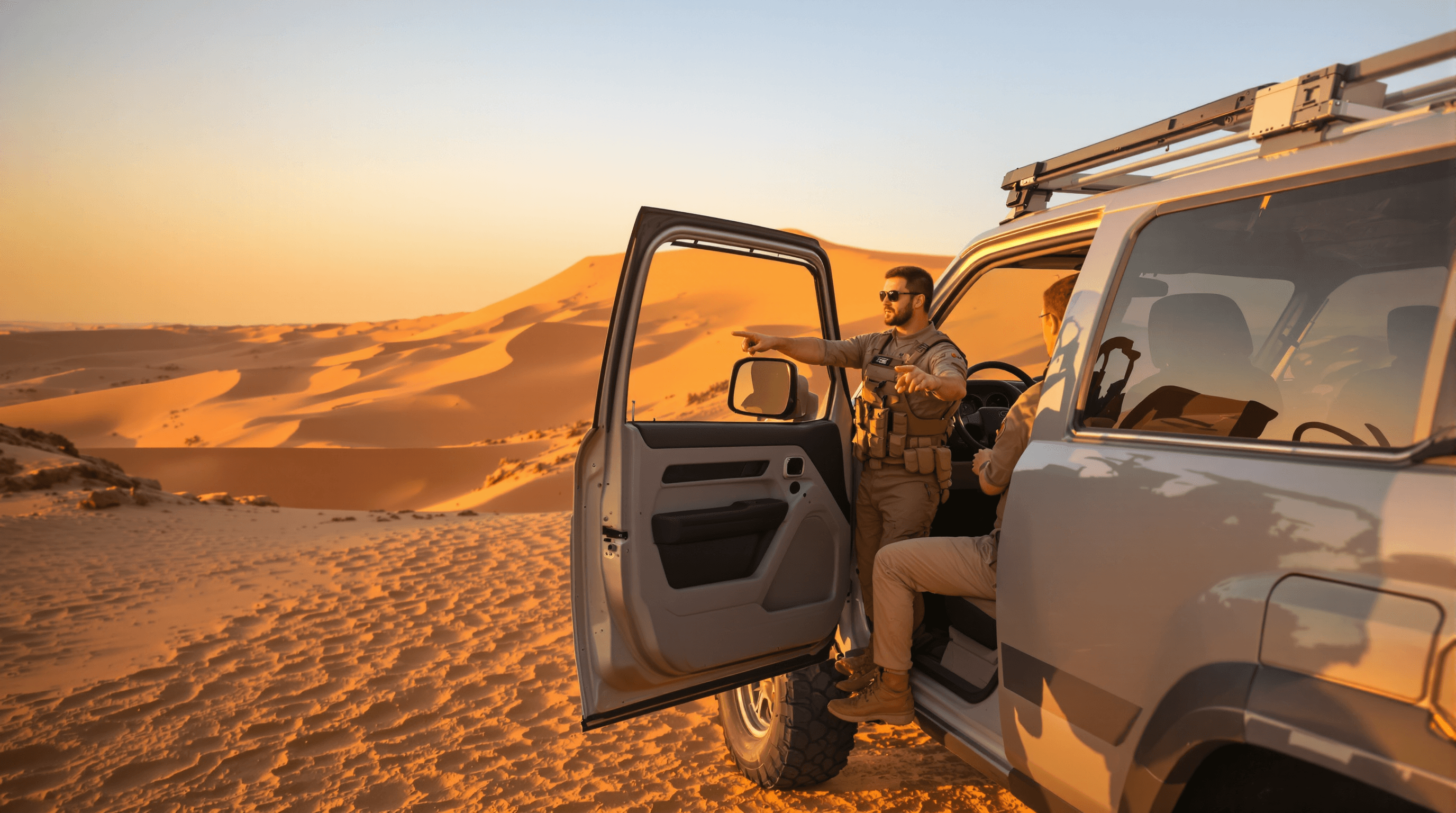
Learning to Off-Road: A Friend or a Proper Instructor?
Should you learn desert driving from a mate or pay for a proper course? An honest look at what each one actually gives you, and how to combine the two.

Learning to Off-Road: A Friend or a Proper Instructor?
Nearly everyone I know who got into desert driving here started the same way: a mate with a Patrol said "come out with us Friday," let some air out of their tyres, and off they went. That's a perfectly good way to catch the bug. It's also how a lot of people end up sat on a dune at 11am, sand under the chassis, wondering why the car that was fine five minutes ago now won't move.
So the question comes up a lot: do you actually need to pay for a course, or is a knowledgeable friend enough? The honest answer is that they're not the same thing, and most people end up wanting both. Here's how I'd think about it.
What a good friend actually gives you
Don't underrate this. Going out with an experienced mate is the cheapest, lowest-pressure way to find out whether you even like the desert. You get the social side, you learn where people actually drive, and you get to make mistakes without an instructor watching the clock.
A good friend will show you the basics that matter most early on — dropping your tyre pressures, keeping your momentum up, not stopping on a soft uphill. They'll pull you out when you bog, which you will. And they'll teach you the unwritten stuff: never drive out alone, who carries the recovery gear, what time to leave before it gets too hot.
The limitation is that friends teach you what works for them, on the terrain they know, usually without being able to explain why. You learn reactively — you find out something was a bad idea after you've already done it. That's fine for a soft dune bash near town. It's a problem the day the conditions are different and your memorised tricks don't apply.
If you're going down this route, it's worth being a bit deliberate about it rather than just tagging along — pick someone patient, ask them to actually talk you through things, and build up gradually.
What an instructor gives you that a friend usually can't
The thing a course buys you is structure and reasons. A decent instructor doesn't just say "give it more throttle here" — they explain why momentum and tyre pressure and dune shape interact the way they do, so you can read a new situation instead of pattern-matching to old ones.
The other big one is recovery. A lot of people learn to drive reasonably well and never properly learn to get unstuck, which is backwards — getting stuck is normal, and being unable to self-recover safely is what turns a minor bog into a long, dangerous afternoon. A proper course will put real time into recovery boards, snatch straps, jacks and how not to hurt yourself or your gear doing it. Friend outings rarely cover this in any methodical way.
You also get a controlled environment: a briefing, someone watching who can stop you before a mistake gets expensive, and the chance to deliberately practise things like a steep descent or a side-slope on purpose, instead of stumbling into them.
The money side, honestly
Cost is the usual reason people skip a course, and it's fair to weigh it up. A multi-day course isn't trivial money, and prices vary a lot depending on group size and whether a vehicle is provided — worth getting current quotes from a few providers rather than trusting any single figure.
What's easy to forget is the other side of the ledger. A recovery call-out in a remote area isn't cheap, and that's before any damage to suspension, diffs or bodywork from doing something wrong at speed. You don't need many avoided incidents for a course to have paid for itself. It's also worth asking your insurer — some will look more favourably on drivers who've done recognised training, so it's worth a phone call.
So which one?
It honestly depends on what you want to do.
If your plan is the occasional weekend dune bash close to the city with people who know the area, learning from friends is genuinely enough to get going. The terrain near town is forgiving, you're never far from help, and you'll pick things up.
The moment you start thinking about remote trips, overnighters, or anything technical, the gaps in informal learning start to matter — particularly recovery and decision-making when things go sideways. That's where a course earns its keep.
My actual recommendation: start with a friend to see if you like it and learn the rhythm of a desert day, then do a proper course once you're hooked, to fill in the recovery skills and the why behind the technique. The two complement each other — the friend gives you the culture, the course gives you the foundation.
If you do book a course
A few things that make training more useful:
- Bring your own 4x4 if you can. Every vehicle feels different in sand, and learning on the car you'll actually drive is far more useful than learning on the school's.
- Practise airing down and back up at home first, so you're not holding the group up fumbling with a deflator.
- Ask questions constantly. A good instructor wants that, and the "why" is the part you can't get from watching.
- Don't treat the course as the finish line — join a club or a regular group afterwards so you keep the skills warm.
You can compare providers in the courses directory, and once you've found people to drive with, the clubs directory is a good place to start.
A couple of common questions
Do I need my own car for a course? No — plenty of providers supply training vehicles. But if you own a 4x4, take it. Learning your own car's weight, traction systems and quirks is far more transferable than learning on something you'll never drive again.
Is it safe to go out with no training at all? The desert is unforgiving if you treat it casually, but the bigger risks are very manageable with sensible habits regardless of how you learned: never go alone, drive in a group of at least three vehicles, and always carry recovery gear and water. Training shortens the learning curve and makes you safer faster, but those basics matter from day one.
Is a friend or a course "better"? Wrong question, really. A friend is the best way to start and stay social; a course is the best way to learn recovery and the reasoning behind the technique. Do both, in that order, and you'll be a more capable driver than someone who only ever did one.
Reviewed by experienced desert drivers. Our team personally visits operators and tests courses across the UAE.
Browse All Desert Driving Courses
Compare prices, locations and reviews for every course in Dubai & UAE.
View Directory →