Land Rover Defender in the UAE: What It's Really Like Off-Road
An honest look at the modern Land Rover Defender as a UAE desert vehicle — its real strengths in the sand, where it gets fussy, and what owning one here costs.
Land Rover Defender in the UAE: What It's Really Like Off-Road
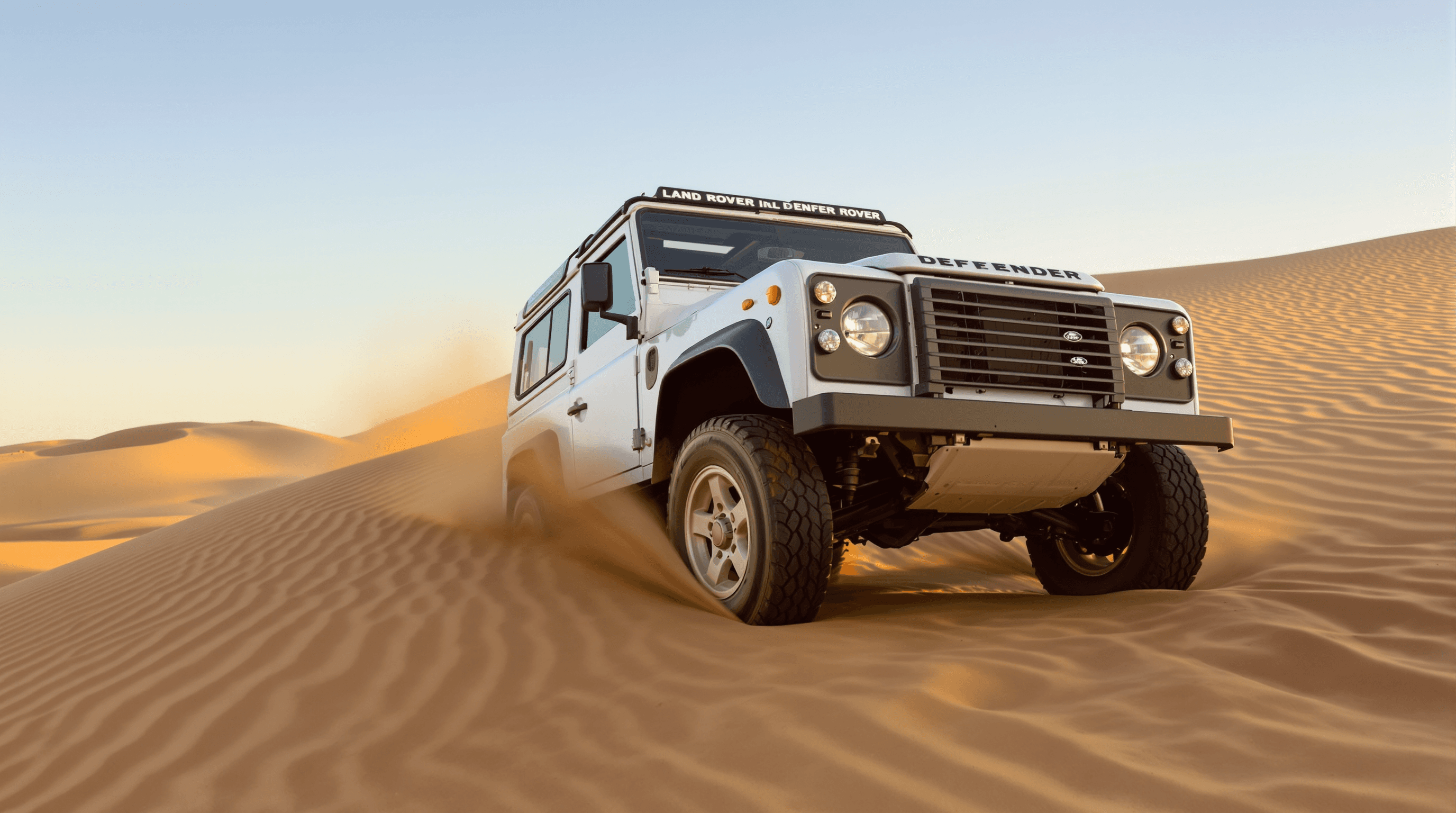
For years the Defender was the truck purists insisted you bought used and built yourself. The new one threw that out — it's an aluminium-bodied, air-sprung, screen-heavy SUV that has almost nothing in common with the old Land Rover except the name. The fair question for anyone in the UAE is whether all that cleverness actually helps in the sand, or just gives you more things to worry about an hour from the nearest tarmac. Having spent time in them out in Al Faya and the Liwa dunes, the short answer is: it's genuinely capable, and it's genuinely more demanding to live with than the Japanese default.
You'll see two body styles here — the short-wheelbase 90 and the long-wheelbase 110 (plus the larger 130). Engines run from a 2.0-litre turbo four through a 3.0-litre mild-hybrid straight-six up to a supercharged V8. Check current Land Rover UAE pricing and the exact engine line-up when you shop, because both move around year to year.
Which engine for the desert
If you're driving sand regularly, the straight-six is the one to have. The extra low-down torque and the way it picks up off idle make a real difference holding momentum through soft sections — the four-cylinder will do it, but you work it harder and it feels more strained when the dune steepens. The V8 is enormous fun and complete overkill; you're paying a lot for performance the desert never asks for.
The air suspension is the headline feature. In off-road mode it lifts the body to around 291mm of clearance, and there's a wade setting that raises it further with a quoted wading depth of about 900mm. Terrain Response 2 has a dedicated Sand program that softens throttle response and manages wheelspin for you, and it works — on a stock car it makes the truck very easy to drive in the dunes, which is part of the appeal and part of the catch (see below).
The tech that actually earns its place
Two things stand out as genuinely useful here rather than gimmicks:
- ClearSight Ground View stitches the camera feeds into a "see-through bonnet" view on the screen, so you can see what's directly under the nose. Cresting blind dunes and picking a line through rock in Hatta or the Fujairah mountains, it's the kind of thing you don't think you need until you've used it.
- All-Terrain Progress Control is essentially low-speed cruise control for off-road — set a crawl speed and the truck manages the throttle and braking while you steer. It takes the panic out of tricky descents for newer drivers.
The flip side: all of this rides on electronics and air. When it's working it's superb. When a sensor sulks in the heat or sand finds its way into an air-suspension component, you've got a problem that a Land Cruiser owner simply never has. That trade-off is the whole story of owning a Defender here.
Where it shines, where it doesn't
In moderate dunes the Defender is excellent — composed, easy, and it doesn't overheat its way into limp mode the way some worry it will, provided you're sensible. The long-wheelbase 110 is the more stable, more comfortable choice and is what most UAE buyers want; the 90 is more agile in tight technical stuff but you have to be more careful about your line on steep faces because of the short wheelbase.
On rock — Jebel Jais, the Hatta wadis, Musandam — the suspension travel and articulation are genuinely good and the ride quality is in another league from a solid-axle truck. The honest limitation is the soft underbelly: this is an expensive, complex vehicle, and the consequences of dragging it over a hidden rock are higher than on something agricultural. People drive them hard out here, but the ones who keep them nice are picky about lines and run proper underbody protection.
Sensible modifications
Defender mods out here lean toward protection and cooling rather than chasing power — there's plenty of power already. The first things worth fitting:
- Rock sliders and underbody / bash plate protection. Top of the list given how much exposed alloy and how many sensors live underneath.
- Auxiliary lighting if you do night runs.
- A dual-battery setup if you're running a fridge, lights or a winch on longer trips.
- A roof rack if you're loading up for overlanding.
Two warnings from people who've done it. A winch install is not a casual job on this car — the aluminium structure and crash sensors mean it needs doing properly by someone who knows the platform, both to make it work and to keep your warranty intact. And summer is the real test: in the worst heat, hard sustained sand work pushes the cooling, so don't push a stock car to its limit in July and assume it'll be fine. A workshop that actually knows Defenders is worth more than the cheapest quote — Dubai's 4x4 garages include specialists who do.
Living with one in the UAE
No way around it: a Defender costs more to run than a Patrol or a Land Cruiser. Servicing is pricier, insurance is higher, and the more specialised off-road parts can mean a wait when they have to come from Europe. Common everyday items are stocked locally and the dealer network is solid, but you are signing up for premium-European running costs, not Toyota ones.
The recurring owner gripes are software niggles in the infotainment and terrain systems, and air-suspension wear from sand getting where it shouldn't — both more about fiddliness than the truck stranding you. Plan on more frequent air-filter changes in this dust, wash the underbody properly after beach and sabkha drives, and keep an eye on the cooling system.
So should you buy one
If your priority is the cheapest, most bulletproof way to spend weekends in the dunes, this isn't it — and the people who tell you to buy a Land Cruiser aren't wrong. But the Defender does something they don't: it's hugely capable off-road and a genuinely lovely, modern thing to drive the rest of the time, and the ClearSight cameras and crawl control flatter your driving on hard terrain. Buy it with your eyes open about the running costs and the electronics, and it's a brilliant desert truck. Buy it expecting Toyota-grade indifference to neglect, and it'll disappoint you.
If you want to compare it against the desert standard-bearer first, our Land Cruiser 79 "Troopy" guide lays out the other end of the philosophy.
FAQ
Is the new Defender reliable enough for UAE desert use? The mechanical side is robust; what catches owners out is the electronics and air suspension being fussier in heat and sand than a Japanese rival. Maintained properly it's fine — it just demands more attention.
Defender 90 or 110 for Dubai? The 110 for almost everyone — more stable in sand, more space, easier to live with. Choose the 90 only if you specifically want the agility of a short wheelbase on tight technical terrain.
What's the first modification to do? Underbody protection and rock sliders, before anything else. There's a lot of expensive alloy and sensors exposed underneath, and a hidden rock is the cheapest way to ruin an expensive day.
Reviewed by experienced desert drivers. Our team personally visits operators and tests courses across the UAE.
Explore the Directory
Find off-road clubs, courses, garages and events across Dubai & UAE.
View Directory →