Can You Learn Off-Roading With a Friend?
Yes — a more experienced mate is one of the best ways to start off-roading in the UAE. How to structure your sessions, what gear to pool, and where peer learning stops being enough.

Can You Learn Off-Roading With a Friend?
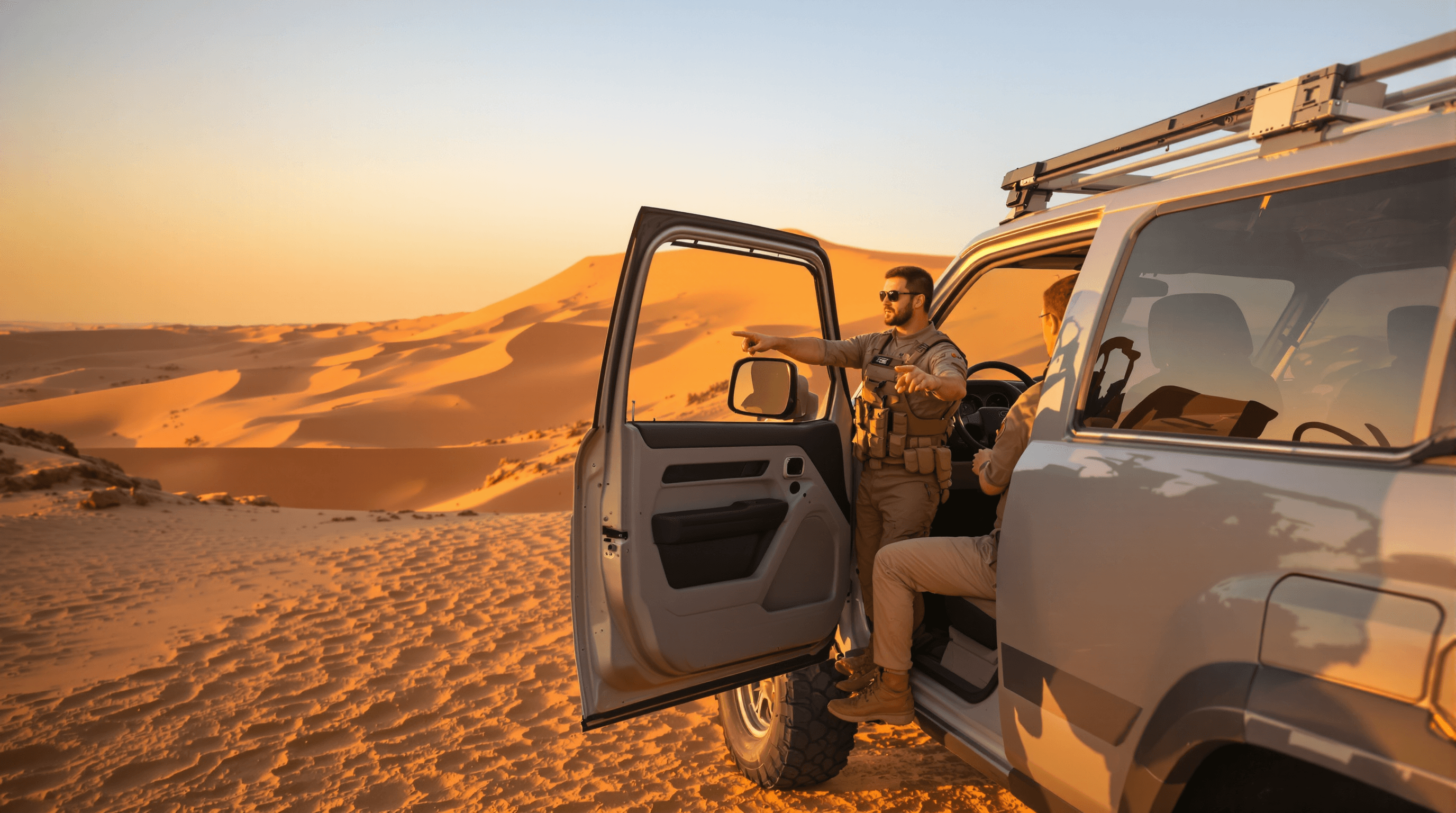
Short answer: yes, and most people in the UAE who can actually drive sand learned it exactly this way — sitting next to a mate, or following their tail lights up a dune until it clicked. There's nothing wrong with that. A friend who already knows what they're doing is one of the cheapest and fastest ways into the sport, as long as you're honest about where it stops working.
The big advantage is feedback in real time. When you bog the car halfway up a slope, someone who's done it a hundred times can tell you why before you've even finished swearing — too little momentum, wrong gear, tyres still too hard. You skip a lot of the trial-and-error that makes solo learning slow and occasionally expensive. Just be aware of the trade-off, which I'll come back to: a mate teaches you their habits, good and bad, and they're not always around to spot you from outside the car.
What a friend can actually teach you
A decent amount, honestly. Most of the core stuff transfers fine from one driver to another in the field:
- Tyre pressures. This is the single biggest thing beginners get wrong, and it's the easiest to teach hands-on. Dropping to somewhere around 15–18 PSI for soft sand transforms how the car floats — but the right number depends on your tyres, vehicle weight and how soft the sand is, which is exactly the kind of judgement a friend's experience shortcuts.
- Momentum and throttle control. Knowing when to commit and when to back off. You feel this far better with someone calling it from the passenger seat than from any article.
- Reading the sand. Spotting where it goes soft, the dip hidden behind a crest, picking a line up a dune. This genuinely takes years to build on your own and a good mentor compresses it a lot.
- Recovery basics. How to use a snatch strap and recovery boards properly, and just as importantly how to do it safely — a snapped strap or a badly placed shackle hurts people.
- 4H vs 4L. When to engage low range, and what it actually changes.
The catch with all of this: your friend has to actually understand it themselves. Plenty of confident drivers do things that work right up until they don't. If your mate has only ever bashed the same patch of soft dunes, there's a fair bit they can't teach you. For the honest version of where a friend stops and an instructor starts, see friend vs instructor — what's the real difference.
Structuring your sessions
The mistake most pairs make is going straight to the big dunes because that's the fun bit. You'll have a much better time building up.
A sensible rough progression:
- Easy gravel and graded tracks — get comfortable with the car's controls, engaging 4WD, and basic spotter communication before sand is even in the picture.
- Gentle, firm sand — practise airing down and keeping momentum on terrain that won't punish you for stalling.
- Small dunes — approach angles, cresting carefully (slow at the top so you can see what's on the other side), controlled descents with your mate spotting from outside the car.
- Recovery practice — deliberately get the car stuck somewhere safe and run through the recovery while nothing's at stake. Far better than learning it for the first time when you're properly buried.
- A full drive — put it together on a real route once the basics are solid.
Set one or two things to focus on each time rather than trying to absorb everything at once, and have a quick debrief after — what went well, what to fix next time. It sounds formal but it just means you're not making the same mistake three weekends running.
A graded, well-trodden trail is a good step up once you've got the early sessions behind you — the routes directory lists options by difficulty.
Gear: pool it across both cars
The nice thing about learning with someone is you've got two vehicles, so you don't each need to carry everything. But between the two cars you want a proper kit, because half the point of a second vehicle is that it can pull the other one out.
At minimum, across the pair:
- Tyre deflators and a decent inflator — you'll be airing down and back up every trip.
- Recovery boards (sand tracks) — the most useful self-recovery tool there is.
- A rated snatch strap and proper shackles — and the knowledge to use them; this is genuinely dangerous gear if you don't.
- Some way to talk — two-way radios are ideal so your spotter can guide you through a section you can't see hand signals from.
- Offline maps or a GPS — mobile coverage disappears quickly out there.
- Plenty of water, a first-aid kit, and a basic tool kit. Carry far more water than you think you need, especially in summer.
If you're still putting a kit together, the gear directory is a sensible place to start, and trusted garages can sort recovery points and basic desert prep on the car.
Picking the right friend to learn with
This matters more than people assume. The best learning partner isn't necessarily the fastest or most modified driver — it's the one with a couple of proper seasons across varied terrain who's also patient. You want someone happy to stop, explain, and repeat it until it lands, who'll nudge you slightly past your comfort zone without dropping you in over your head.
The flip side worth saying plainly: two total beginners teaching each other is how people end up stranded or rolling a car on a dune face. If neither of you really knows what you're doing, do at least one proper session with an instructor or a club first to get the safety fundamentals straight, then go practise together.
Where the community comes in
A friend is a great start, but no single person has seen everything. Driving with a group exposes you to different terrain, different vehicle setups and different ways of solving the same problem, and there's safety in numbers when something goes wrong. Dubai Offroad and others run beginner-friendly drives and skills days where you'll naturally meet more experienced drivers — browse the clubs directory or the events calendar to find one near your level. If you'd rather get the foundations from a structured course, the courses directory lists what's on offer.
A few common questions
Can two beginners learn together? You can, but be careful with it. Start on genuinely easy terrain and consider doing one session with an instructor or club first so at least one of you has the safety basics down. The failure mode for beginner pairs is confidently driving into something neither of them knows how to get out of.
What's the best place to start in the UAE? Graded gravel tracks and gentle, firm sand on the outskirts of Dubai. You want terrain that lets you practise without punishing every mistake. Save the big soft dunes for when momentum and tyre pressures are second nature.
Do I need a modified 4x4? No. A standard SUV with proper low-range four-wheel drive and reasonable ground clearance will get you a long way, and learning on a stock car teaches you technique instead of relying on hardware. Sort out upgrades later, once you know what you actually need.
Reviewed by experienced desert drivers. Our team personally visits operators and tests courses across the UAE.
Browse All Desert Driving Courses
Compare prices, locations and reviews for every course in Dubai & UAE.
View Directory →