How to Drive in Sand in the UAE — A Beginner's Field Guide
Practical, first-hand advice on driving sand in the UAE: dropping tyre pressures, reading dunes, recovering when you bog, and staying safe in the heat.
How to Drive in Sand in the UAE — A Beginner's Field Guide
The first time you take a 4x4 into soft sand, your instincts will be wrong. You'll want to slow down when you should keep moving, you'll feed in too much steering, and you'll panic-brake the moment the front end starts to wallow — which is exactly how you get stuck. Sand driving isn't hard once it clicks, but almost nothing you learned on tarmac transfers across. This is the stuff I wish someone had drummed into me before my first weekend in the dunes around Dubai.
Before you air down
The single most important thing you'll do all day happens before you reach the sand: drop your tyre pressures. A road-pressure tyre sits on top of soft sand like a knife; a deflated one spreads out, floats, and finds grip.
For most all-terrain tyres on a typical 4x4, somewhere around the low teens (PSI) is a sensible starting point, and you can go lower for very soft sand or heavier vehicles. The exact number depends on your tyre, wheel size and how loaded the car is, so treat it as a feel thing rather than a magic figure — if the car is still digging in, let a bit more out. Just don't run so low that the tyre rolls off the rim on a hard turn.
That makes a 12V compressor non-negotiable. You have to put the air back in before you hit the highway home, and driving any distance on deflated tyres will overheat and ruin them. The rest of what you actually need is short and unglamorous:
- A decent air compressor and a tyre gauge
- Recovery boards (Maxtrax-style)
- A rated recovery strap and a folding shovel
- Plenty of drinking water — far more than you think
- Offline maps on your phone, since signal disappears fast
- A tall sand flag so other vehicles see you coming over a crest
Going out with people who know what they're doing beats any checklist. If you're starting from zero, a proper desert driving course will teach you more in a morning than a season of guessing on your own.
The basics of moving through sand
Sand rewards smoothness and momentum, and punishes hesitation. The mental model that helped me most: you're trying to float across the surface, not claw through it.
Keep the car moving at a steady, moderate pace and use gentle throttle. Stabbing the accelerator just spins the wheels and digs you in; lifting off abruptly does the same thing in reverse. Steer in slow, wide arcs — sharp inputs on soft sand make the front tyres push and the back end slide, neither of which you want, especially on a slope.
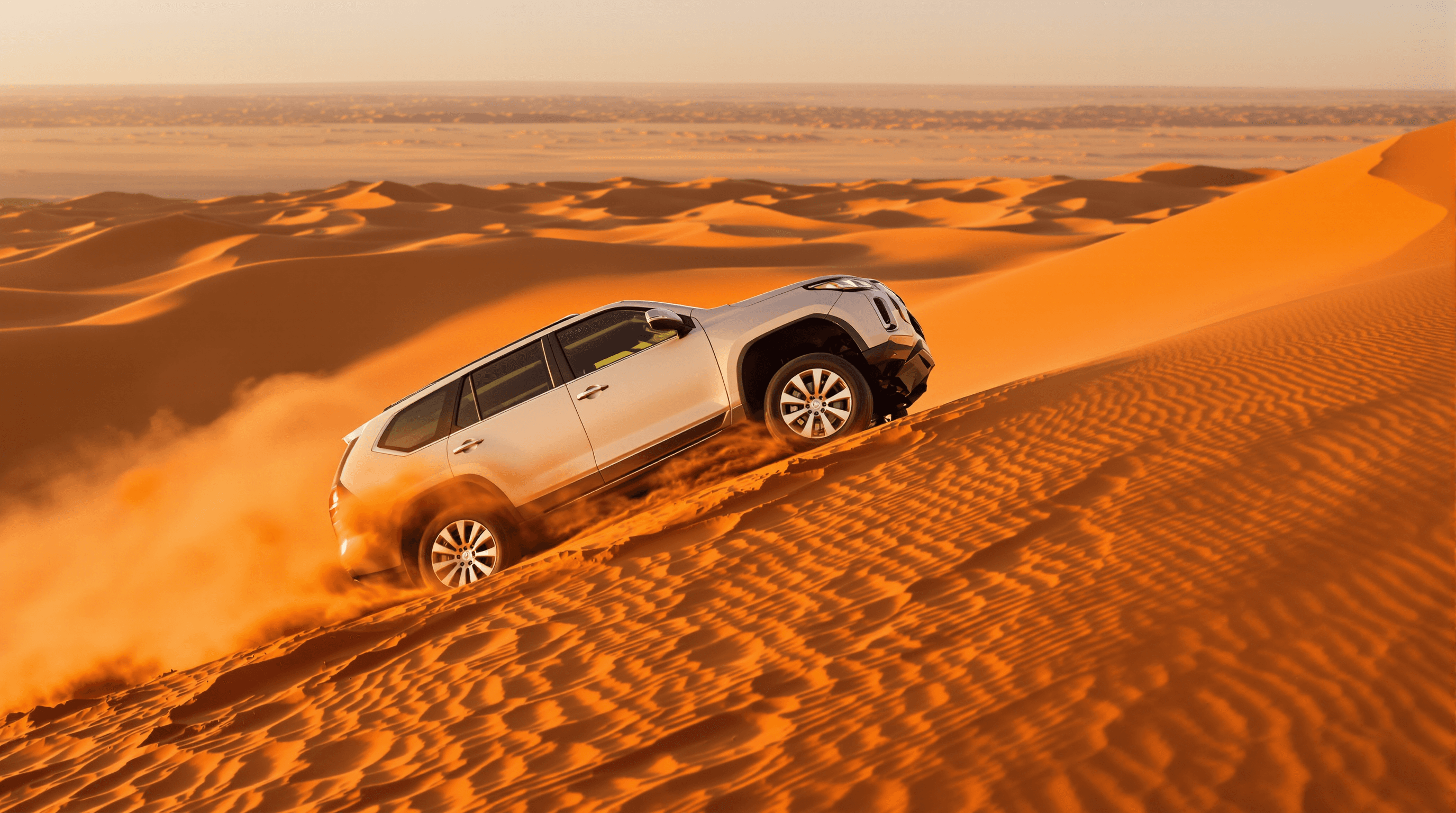
Climbing a dune is where beginners come unstuck, literally. Pick your line, build momentum on the approach, and hold a steady throttle up the face — don't try to accelerate halfway up when you feel it slowing. Drive straight up the fall line, not across it. And the golden rule: if you're clearly running out of steam before the top, don't fight it. Stop accelerating, keep it straight, and let the car roll back down in a straight line so you can have another go. Trying to muscle over the crest blind is how people get airborne or roll.
Coming down the other side, do it slowly and straight. Point the nose down the fall line, let engine braking in low range hold your speed, and keep steering inputs to a minimum. The danger on a descent is the car slewing sideways and tipping; pointing straight down is almost always the safe choice.
Reading the sand
UAE sand isn't all the same, and a bit of reading goes a long way. Cool sand early in the morning is firmer and far more forgiving than the same dune baked soft at midday — which is one reason the early starts are worth it. After rain, the surface firms up for a day or two before it loosens off again, and that's some of the best driving you'll get all year.
You learn to read the surface with experience, but a few patterns hold up. Fresh tyre tracks usually mean the sand underneath is firm enough to carry a car. Smooth, untouched sand can hide soft pockets. The leeward side of a dune — the steep, sheltered slope where wind-blown sand piles up loose — is where the soft traps live, so treat fresh, smooth-looking slopes with respect. If you're not sure how firm something is, there's no shame in walking it first.
In the winter months the sand is generally firmer and the temperatures are kind. In high summer it's softer, you get stuck more easily, and the heat itself becomes the real hazard rather than the driving.
When you get stuck — and you will
Everyone bogs eventually. The trick is to recognise it early and stop spinning the wheels the instant they start to dig, because every extra second of wheelspin buries you deeper.
Get out and look. Clear the sand from in front of (or behind, if reversing out is shorter) each driven wheel, scoop a gentle ramp rather than a vertical hole, and slot your recovery boards hard up against the tyres at a shallow angle. Then drive on gently — the aim is to climb out, not to roast the boards with wheelspin. A spotter outside the car makes this far easier and stops you driving straight off the end of the boards.
If you need a tow, the recovery vehicle should sit on firmer ground with a decent gap of slack, and the pull should be progressive rather than a violent snatch — jerking a strap can hurt people and bend metal on both cars. Winching in sand is its own skill, because there's usually nothing solid to anchor to; you'll need a sand anchor or another vehicle, and steady tension rather than shock loading. If you're regularly going out where you might need it, it's worth getting your recovery technique looked over properly before you rely on it.
Most of the established UAE clubs are generous with recovery help and run trips at a range of levels — the off-road clubs directory is a good place to find one near you.
Staying safe in the heat
The desert kills people through heat and dehydration far more often than through dramatic crashes. That's the part to take seriously.
Go out with at least a couple of other vehicles so someone can pull you out or run for help, agree who's leading and who's sweeping at the back, and have a way to talk between cars. Carry far more water than feels necessary, start early to dodge the worst of the heat, and learn the early signs of heat exhaustion — dizziness, nausea, a thumping headache — so you can call it before it becomes serious.
A few practical rules worth internalising:
- Tell someone reliable where you're going and when you expect to be back.
- Don't lean on phone signal; large stretches of desert have none.
- If the car genuinely breaks down, stay with it and use it for shade. A vehicle is far easier to spot than a person on foot, and walking out in the heat is how rescues turn into emergencies.
On the legal side, stick to public desert and stay out of fenced-off land, conservation areas and wildlife reserves. The protected zones are marked for a reason, and the fines are real.
Does your car matter?
Plenty of vehicles handle sand well with the right technique, but the desert defaults around here are the Toyota Land Cruiser and the Nissan Patrol — both have earned that reputation over decades of local use. You do want proper low-range 4WD; a 2WD car will bury itself in the first soft patch, and there's no technique that fixes that.
If you catch the bug and start thinking about modifications, the useful ones tend to be about traction, cooling and protection rather than chasing power: good tyres, diff locks if your car doesn't already have them, and keeping the engine and transmission cool in the heat. A workshop that actually knows desert use is worth finding before you spend money — the garage directory lists specialists who do this locally.
A few common questions
What's a safe starting tyre pressure for sand? There's no single right number — it depends on your tyre and how loaded the car is — but most people run somewhere in the low teens (PSI) for soft sand and adjust from feel. The important part is having a compressor to reinflate before you drive home.
Do I really need 4WD? Yes. Beyond hard-packed graded tracks, a 2WD vehicle will get stuck almost immediately. Low-range 4WD gives you the control you want for climbing and soft sand.
When's the best time to head out? Early morning and late afternoon. The sand is cooler and firmer, the light is better, and you avoid the worst of the midday heat that softens everything up and makes the day genuinely dangerous in summer.
Reviewed by experienced desert drivers. Our team personally visits operators and tests courses across the UAE.
Explore the Directory
Find off-road clubs, courses, garages and events across Dubai & UAE.
View Directory →