Night Off Roading Dubai: Complete 2024 Guide
Master night off roading in Dubai with expert safety tips, best locations, essential gear, and lighting setups. Transform your desert adventures after dark.

Night Off Roading Dubai: Complete 2024 Guide
Night off roading in Dubai transforms the familiar desert landscape into an entirely different adventure, where cooler temperatures and dramatic moonlit dunes create an unforgettable experience. The UAE's desert terrain offers exceptional opportunities for nocturnal exploration, but requires specialized preparation, enhanced safety protocols, and proper lighting equipment to navigate safely after sunset.
This comprehensive guide covers everything from essential lighting setups and navigation techniques to the best desert locations and safety considerations for night driving in Dubai's challenging terrain.
Essential Lighting Equipment for Night Desert Driving
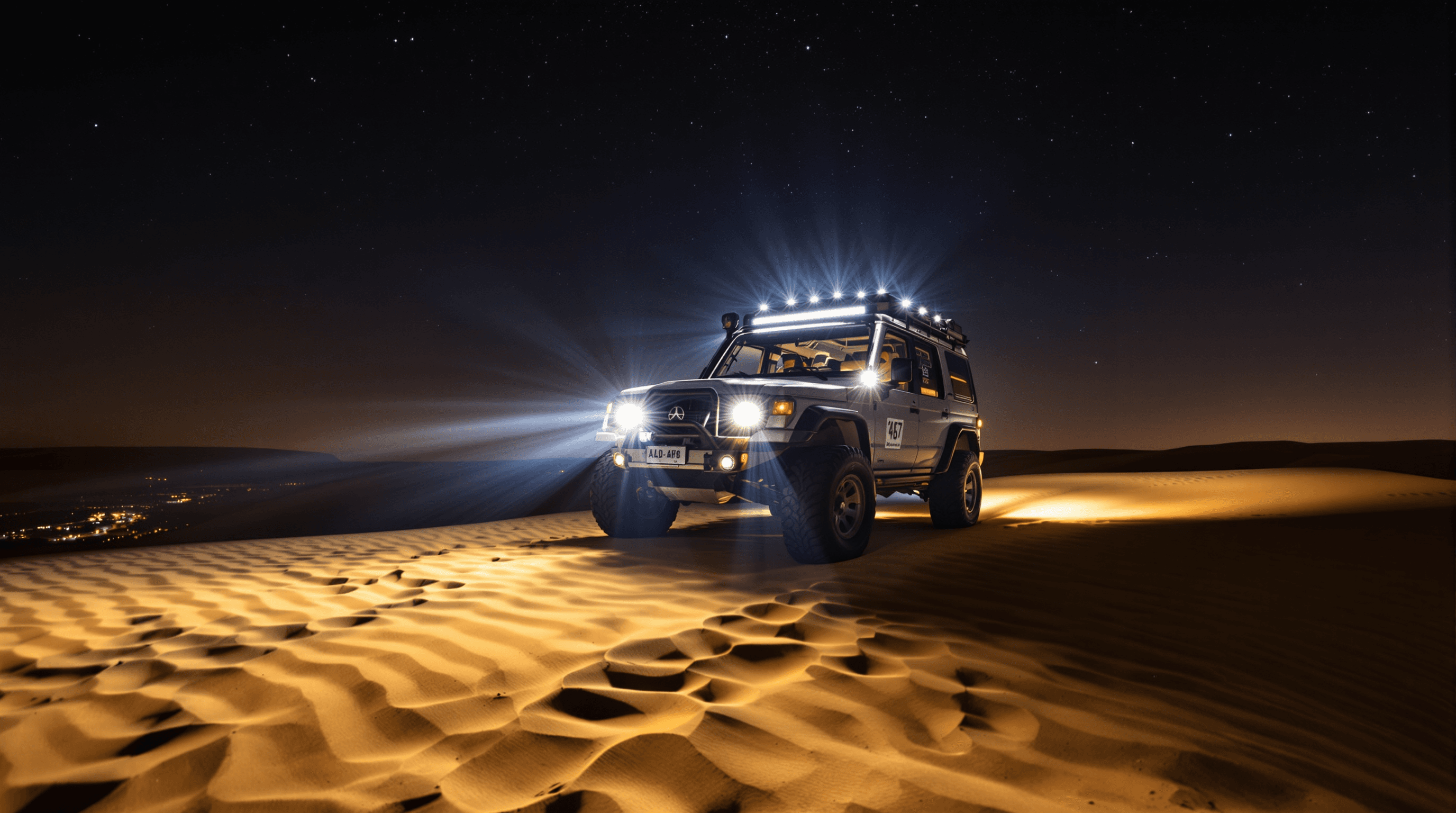
LED light bars with 20,000+ lumens output provide the primary illumination needed for safe night desert navigation. Professional off-road lighting systems typically include a combination of spot and flood beam patterns to handle both long-distance visibility and wide-area coverage around your vehicle.
Your lighting setup should include:
• Primary light bar: 40-50 inch curved LED bar mounted on roof or bull bar (25,000-30,000 lumens) • Auxiliary spots: Two 6-9 inch LED pods for long-range visibility (3,000-5,000 lumens each) • Side lighting: Rock lights or side-mounted floods for obstacle detection during technical sections • Rear lighting: Reverse lights and work lamps for recovery operations • Portable spotlights: Hand-held 2,000+ lumen spotlights for ground reconnaissance
Quality brands like Rigid Industries, Vision X, and Baja Designs offer lighting systems specifically designed for desert conditions, with sealed housings that withstand sand infiltration and temperature extremes. Budget for AED 3,000-8,000 for a complete professional lighting setup.
The key to effective night desert lighting is layered illumination that eliminates blind spots while avoiding glare that compromises your natural night vision adaptation.
Best Desert Locations for Night Off Roading
Al Qudra Desert offers the most accessible night driving terrain within 45 minutes of Dubai, with well-established tracks and minimal light pollution. This location provides diverse terrain from gentle rolling dunes to more technical sections, making it ideal for both beginners and experienced night drivers.
Popular night off roading destinations include:
• Al Qudra Desert: Closest to Dubai, good cell coverage, established camping areas • Sweihan Desert: Larger dune systems, more challenging terrain, darker skies • Liwa Desert: Advanced drivers only, massive dunes, remote location requires satellite communication • Fossil Rock area: Mixed terrain with rocky sections, requires technical lighting setup • Big Red Dune: Popular but crowded, good for first night attempts with other groups
When selecting night driving locations, prioritize areas you've previously explored during daylight hours. Familiar terrain reduces navigation errors and allows you to focus on adapting your driving techniques to night conditions rather than learning new routes simultaneously.
Always inform someone of your planned route and expected return time. Our courses directory lists several operators who offer guided night driving experiences for those new to nocturnal desert exploration.
Safety Protocols and Navigation Techniques
GPS navigation becomes critical for night desert driving as visual landmarks disappear, requiring backup navigation systems and waypoint marking for safe return routes. Professional desert drivers use multiple GPS units, offline mapping applications, and physical compass bearings to maintain situational awareness in darkness.
Essential safety protocols include:
• Pre-drive reconnaissance: Scout routes during daylight within 24-48 hours of night drive • Convoy requirements: Minimum 2 vehicles, maximum 6 for group safety and communication • Communication systems: UHF radios on all vehicles, satellite messenger for emergencies • Emergency supplies: Extra water (4L per person), food, blankets, first aid kit, tools • Recovery gear: Sand ladders, winch, tow straps, shovel, air compressor
Navigation techniques for night driving differ significantly from daytime methods. Use GPS coordinates rather than visual landmarks, mark waypoints every 2-3 kilometers, and maintain constant communication between vehicles to prevent separation. Reduce normal driving speeds by 30-40% to accommodate reduced visibility and reaction time.
Experienced guides from our off-road clubs directory often organize night drives that provide structured learning opportunities for developing these specialized skills safely.
Vehicle Preparation and Technical Considerations
Electrical system capacity becomes the limiting factor for night off roading, requiring alternator upgrades and auxiliary battery systems to power high-draw lighting equipment continuously. Standard vehicle electrical systems typically cannot support professional lighting loads without modifications.
| Component | Standard Specification | Night Driving Requirement |
|---|---|---|
| Alternator | 120-150 amp | 200+ amp high-output |
| Battery | Single 70-80Ah | Dual battery system 100Ah+ each |
| Wiring | 14-16 gauge | 10-12 gauge with relays |
| Fuses | Standard automotive | Heavy-duty blade fuses 40-60A |
Vehicle preparation checklist:
• Electrical upgrades: High-output alternator, dual battery system, heavy-duty wiring harness • Cooling system: Additional cooling capacity for extended low-speed operation • Air filtration: Upgraded air filters and pre-cleaner systems for dusty conditions • Emergency equipment: Jump starter, tire repair kit, emergency lighting, satellite communication
The investment in proper electrical systems typically ranges from AED 2,500-5,500 depending on your vehicle and lighting requirements. Many off-road garages in Dubai specialize in these modifications and understand the specific demands of desert night driving.
Consider starting with a basic lighting setup and gradually upgrading as you develop night driving experience and identify specific needs for your preferred terrain types.
Weather Conditions and Seasonal Considerations
October through March provides optimal conditions for night off roading in Dubai, with temperatures dropping to 15-25°C after sunset and stable weather patterns. Summer night driving remains possible but requires additional precautions due to residual ground heat and potential sandstorm activity.
Seasonal factors affecting night desert driving:
Winter months (December-February): • Ideal temperatures for extended drives • Clear skies and excellent visibility • Potential for morning fog in low-lying areas • Increased camping and overnight trip opportunities
Spring/Fall transition (March-April, October-November): • Variable weather patterns requiring flexible planning • Potential for sudden temperature changes • Optimal balance of comfort and clear conditions
Summer considerations (May-September): • Ground temperatures remain elevated until midnight • Higher risk of mechanical overheating • Limited comfortable driving windows • Essential to carry extra cooling system supplies
Weather monitoring becomes more critical for night operations as you cannot visually assess approaching conditions as easily as during daylight hours. Use reliable weather applications and satellite weather imagery to track regional conditions before departure.
The UAE's desert climate offers some of the world's clearest night skies, providing natural illumination from stars and moon phases that experienced drivers learn to utilize effectively. Plan night drives around lunar cycles when possible, as full moon conditions significantly improve natural visibility.
Advanced Night Driving Techniques
Depth perception changes dramatically in artificial lighting, requiring modified approach angles and speed control techniques compared to daylight desert driving. Professional night drivers develop specific visual techniques to read terrain features under LED illumination patterns.
Key technique modifications include:
• Speed reduction: Maintain 60-70% of normal daylight speeds • Following distances: Double normal spacing between vehicles in convoy • Approach angles: Use lighting to pre-read terrain features 20-30 meters ahead • Side slope assessment: Deploy portable spotlights for technical sections • Recovery positioning: Establish lighting perimeter before attempting stuck vehicle recovery
Night driving technique development benefits significantly from structured learning with experienced instructors. Our guide on what actually happens in your first off-road lesson covers foundational skills that become even more important in night conditions.
Visual adaptation techniques help maximize your natural night vision capabilities. Avoid looking directly at bright lights, use red-filtered lighting for map reading and vehicle controls, and allow 15-20 minutes for initial dark adaptation before beginning technical driving sections.
Understanding how different lighting angles affect shadow patterns and depth perception takes practice in controlled environments before attempting challenging terrain. Many drivers practice these skills in familiar areas like Al Qudra Desert before progressing to more remote locations.
Equipment Maintenance and Power Management
Battery management systems and power distribution become critical for multi-hour night driving sessions, requiring monitoring equipment and load management strategies. Professional setups include voltage monitoring, automatic load shedding, and backup power sources.
Power management essentials:
• Battery monitoring: Digital voltage displays showing real-time system status • Load controllers: Automatic systems that reduce lighting loads when voltage drops • Backup power: Portable power stations for emergency lighting and communication • Charging systems: Solar panels or DC-DC chargers for extended trips
Regular maintenance schedules become more important when operating high-power lighting systems in dusty desert conditions. LED lights require cleaning after each use, electrical connections need periodic inspection for corrosion, and cooling systems require more frequent service.
Budget for ongoing maintenance costs of approximately AED 500-1,000 annually for a well-used night driving setup, including replacement bulbs, wiring repairs, and battery maintenance. Quality equipment reduces these costs significantly compared to budget alternatives that fail in harsh desert conditions.
Group Dynamics and Communication
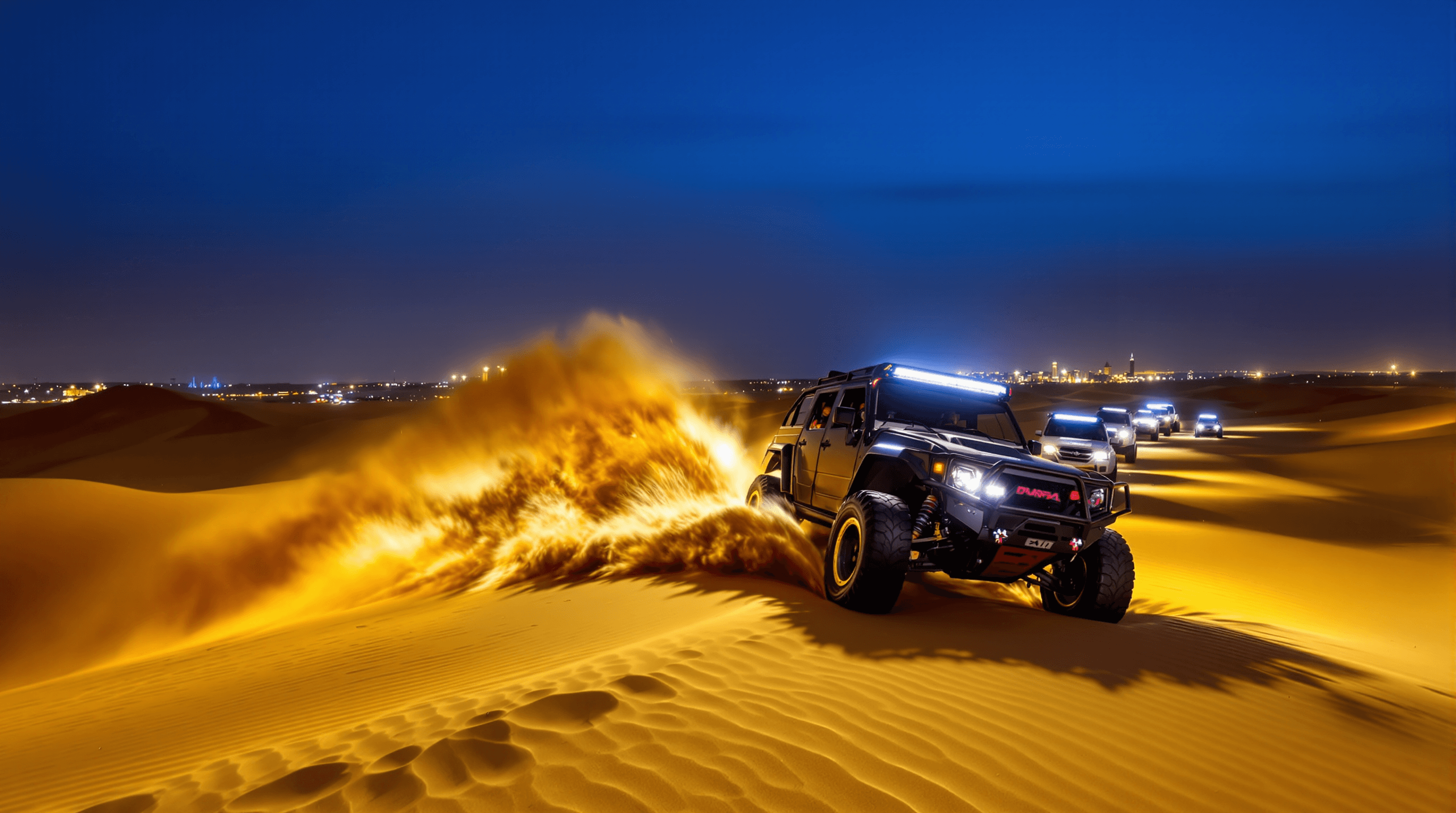
Night convoy operations require enhanced communication protocols and designated role assignments to maintain group safety and navigation accuracy. Standard daytime convoy procedures must be modified to account for reduced visibility and increased risk factors.
Effective night group organization includes:
• Lead vehicle: Experienced night driver with primary navigation responsibility • Sweep vehicle: Most capable recovery setup, maintains rear position • Communication lead: Dedicated radio operator monitoring emergency frequencies • Navigation backup: Secondary GPS operator verifying route accuracy
Radio discipline becomes more important during night operations when visual signals are ineffective. Establish clear communication protocols, regular check-in schedules, and emergency procedures before departure. Many Dubai off-road groups use standardized procedures developed through organizations listed in our off-road clubs directory.
Group size optimization for night driving typically ranges from 3-5 vehicles, providing adequate safety backup while maintaining manageable communication and navigation coordination. Larger groups create coordination challenges, while smaller groups may lack sufficient emergency response capability.
Frequently Asked Questions
Is night off roading legal in Dubai desert areas? Night off roading is legal in designated desert areas around Dubai, including Al Qudra, Sweihan, and other public desert zones. Avoid protected areas, private property, and areas with posted restrictions. Always follow Leave No Trace principles and respect local regulations.
What's the minimum lighting setup needed for safe night desert driving? A basic safe setup requires a primary LED light bar (20,000+ lumens), auxiliary spot lights, and portable emergency lighting, with total investment of AED 2,500-4,000. This must be supported by adequate electrical system capacity including dual batteries or high-output alternator.
How much does it cost to prepare a vehicle for night off roading? Complete night off-road preparation typically costs AED 5,000-12,000 including lighting, electrical upgrades, and safety equipment. Basic setups start around AED 3,000, while professional-grade systems can exceed AED 15,000 depending on vehicle requirements and terrain focus.
What are the biggest safety risks of night desert driving? Primary risks include navigation errors leading to becoming lost, mechanical failures in remote areas, reduced visibility causing rollovers or collisions, and delayed emergency response due to location and darkness. Proper preparation and group protocols mitigate these risks significantly.
Can beginners safely attempt night off roading in Dubai? Beginners should complete daytime desert driving courses and gain substantial daylight experience before attempting night driving. Start with guided night experiences through established operators, then progress to familiar terrain with experienced groups before independent night driving.
What weather conditions should cancel night off roading plans? Cancel night drives during sandstorms, high winds over 30 km/h, fog conditions, or severe weather warnings. Poor visibility, electrical storms, or extreme temperature conditions also warrant postponement. Always check weather forecasts and satellite imagery before departure.
Reviewed by experienced desert drivers. Our team personally visits operators and tests courses across the UAE.
Explore the Directory
Find off-road clubs, courses, garages and events across Dubai & UAE.
View Directory →