Dual Battery Setups for 4x4s in the UAE — What You Actually Need
A practical look at dual battery systems for UAE off-roaders: why you'd want one, the battery and isolator choices that matter, wiring sense, and keeping it alive in desert heat.
Dual Battery Setups for 4x4s in the UAE
The moment you start running a fridge overnight, or you've sat in the dunes winching a mate out for ten minutes, you understand why people fit a second battery. A single starter battery is fine until it isn't — and the time it lets you down is always the morning you're parked somewhere remote and the engine won't turn over because the fridge ran all night. A dual battery setup keeps your starting battery untouched and gives your accessories their own power to drain.
It matters more here than in cooler climates. UAE summer heat is brutal on batteries — capacity drops as temperatures climb, and an engine bay sitting in 45°C-plus air is a hard place to keep a battery healthy. If you camp out at Liwa or do long days away from help, a reliable second battery is genuinely a safety item, not just a comfort one.
How the system works
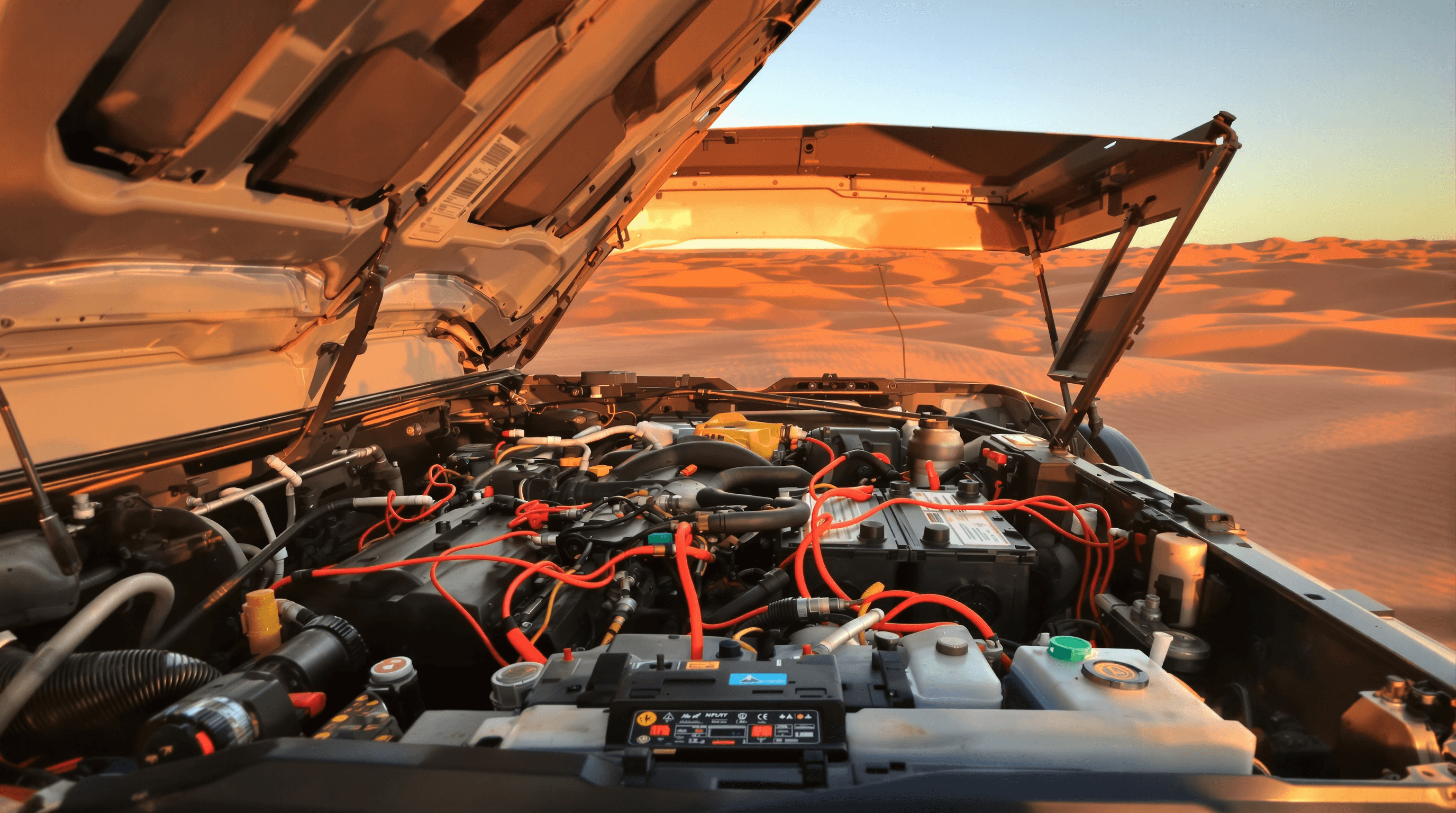
The core idea is simple: your starter battery handles the engine and the vehicle's own electronics, and a second auxiliary battery handles everything you bolt on — fridge, lights, compressor, charging. Something sits between the two so they charge together off the alternator when the engine's running, but the auxiliary can't pull the starter battery flat when you're parked.
That "something" is usually one of a few things:
- VSR (voltage-sensitive relay) — the cheap, simple option. It links the batteries once the alternator brings the voltage up and disconnects them when it drops. Does the job for basic setups.
- DC-DC charger — smarter and the better choice if you run AGM or lithium. It delivers a proper charging profile to the auxiliary battery regardless of what the alternator is doing, which matters in heat and for getting a deep-cycle battery fully charged.
- Manual switch — some experienced people just run a switch they control themselves. Fine if you'll actually remember to use it.
If you're spending real money on the battery, spend it on a DC-DC charger too. A VSR will charge a lithium battery, but not well.
Picking a battery
For most people here, AGM is the sensible default. It tolerates heat and vibration well, doesn't need venting, and won't spill when you're crawling over rocks. It's the standard you'll see in most UAE 4x4 setups for good reason.
Lithium (LiFePO4) is the upgrade. It's a lot lighter than AGM for the same capacity, charges faster, and lasts far longer in cycle terms, so if you're doing serious overlanding and the weight and longevity matter to you, it's worth the bigger upfront spend. For weekend trips, plenty of people are perfectly happy on AGM and never feel the need to switch.
Avoid cheap flooded batteries for an auxiliary in this climate — they don't cope with the heat or the deep discharge the way deep-cycle AGM or lithium does.
A 100Ah auxiliary covers typical weekend loads — a fridge, lights, charging — comfortably. If you're running heavier kit or staying out longer, look at more capacity or adding solar rather than pushing one battery to its limit. Brands like Optima, Odyssey and Victron have local presence; any decent 4x4 workshop can point you at what they stock and trust.
Wiring and safety
This is the part people get wrong, and it's the part that starts fires or cooks an alternator.
Fuse each battery close to its positive terminal — that's the protection that actually matters if a cable chafes through. Use cable heavy enough for the run; undersized cable in desert heat means voltage drop and heat buildup, neither of which you want. Marine-grade tinned copper holds up far better against humidity and corrosion than cheap automotive wire.
Don't skimp on the grounds. Bad ground connections cause more dual-battery headaches than anything else — voltage drop, charging that never quite completes, intermittent gremlins. Run proper ground cable to clean chassis points rather than trusting a crusty engine-bay bolt.
And mind where the cables run: away from heat sources, moving parts and sharp edges, secured properly and sleeved where they pass anything that could rub. A cable that melts or chafes through mid-trip is a miserable thing to diagnose in the field.
A basic voltage display is worth having so you can see what your system's doing at a glance; battery monitors that track amp-hours used are a nice step up if you camp out a lot.
This is also why a lot of people pay to have it done. A clean professional install with the right fusing and cable is money well spent, and many off-road garages offer complete dual-battery packages. If you're confident with auto electrics it's a doable DIY job over a day, but get the fusing and grounds right.
What's actually drawing power
Sizing the system comes down to knowing what your kit pulls. Rough figures worth keeping in mind:
- A 40L 12V fridge is the big steady draw — it cycles on and off, and how hard it works depends heavily on ambient heat.
- LED lighting is modest by comparison.
- An air compressor pulls a lot while it runs, but only intermittently — when you're airing back up at the end of a run.
- A winch is in a class of its own: huge, sustained draw during a recovery.
The winch is exactly why isolation matters. A long winch pull can take a real bite out of a battery, and you do not want that battery to be the one starting your engine. Some people run the winch straight off the auxiliary (or a dedicated battery) for this reason. The compressor is the other heavy hitter, but because it's short bursts it's less of a planning problem than the fridge running all night.
For a weekend with the usual fridge-lights-charging mix, a 100Ah auxiliary handles it. If you keep running things flat, you either need more capacity or a way to top up while you're out — which is where solar comes in.
Keeping it alive in the heat
UAE conditions are hard on this stuff, so a little maintenance goes a long way.
Check resting voltage now and then — a healthy battery sits a touch above 12.6V at rest and should climb into the 13s and 14s while charging. Consistently low readings mean something's wrong: a tired battery, a poor connection, or a charging fault worth chasing before it strands you.
Keep terminals clean. The coastal humidity here corrodes connections faster than you'd expect, especially on vehicles that spend time near the water. A clean terminal and a bit of protection saves you the resistance and charging problems that corrosion brings.
Heat is the quiet killer. An auxiliary battery baking in the engine bay all summer will not live as long as one mounted somewhere cooler. If you've got the option, keeping the battery out of the worst of the engine heat genuinely extends its life.
Going further: solar and inverters
If you camp for several days at a time, solar turns the setup into something close to self-sufficient. A roof or fold-out panel feeding through a DC-DC charger with a solar input tops the auxiliary up through the day and takes the pressure off your alternator. A small pure sine wave inverter adds 240V for laptops and camera gear if you need it.
None of this is essential for a weekend in the sand — but for longer trips well away from help, being able to keep your power topped up off the sun is the difference between rationing the fridge and not thinking about it.
A few common questions
How long will a 100Ah battery run a fridge overnight? It depends a lot on heat. In mild conditions a quality 100Ah AGM will comfortably run a 40L fridge overnight and then some; in peak summer the fridge cycles far harder and battery capacity drops with temperature, so you get noticeably less. If you're camping in the heat, that's the load to plan around.
VSR or DC-DC charger? A VSR is cheaper and simpler and fine for a basic AGM setup. A DC-DC charger charges properly in heat and is the right call for lithium or if you want your AGM fully and reliably charged. If the battery's worth real money, fit the DC-DC.
Can I install it myself? If you're comfortable with auto electrics and you get the fusing, cable sizing and grounds right, yes — it's a day's work. If any of that is unfamiliar, pay a good 4x4 workshop. Bad wiring here can mean a fire or a fried alternator, not just a fault code.
Reviewed by experienced desert drivers. Our team personally visits operators and tests courses across the UAE.
Shop 4x4 Gear & Accessories
Recovery gear, winches, tyres and accessories from top UAE shops.
View Directory →