Suspension and Beyond: Building a 4x4 That Matches Your Skills
A staged approach to modifying your 4x4 in the UAE — lift, shocks, lockers and beyond — built around your driving skill rather than your shopping list.
Suspension and Beyond: Building a 4x4 That Matches Your Skills
The most common mistake I see in the dunes isn't bad driving — it's a beginner sitting in a heavily modified rig that's miles ahead of their experience. Lockers, a five-inch lift, big mud-terrains, and a driver who's only done a handful of trips. The vehicle can do more than the person behind the wheel, and that gap is where the recovery calls and the broken parts come from.
A stock 4x4 off the showroom floor is a starting point, not a finished tool. But the order you build it in matters as much as what you buy. The smart way to modify is to let your hardware follow your skill, not the other way around. Spread the cost over time, learn the car at each step, and you end up with a more capable rig and a far better driver. Here's roughly how that progression looks.
Why build in stages
Building progressively works for two reasons. First, your budget gets to breathe — you're not dropping AED 40,000 in one go on parts you don't yet know how to use. Second, you actually learn the vehicle at each step. A locker behaves nothing like an open diff. Long-travel suspension changes how the car loads up over a dune crest. If you bolt all of that on at once, you've changed too many variables to understand any of them.
I've watched people start with a modest two-inch lift, spend a year genuinely learning throttle control and line choice, and only then move up to a serious suspension setup. By the time they get there, they know exactly why they want it. Those drivers tend to be the ones leading trips a couple of years later, not the ones getting dug out of a bowl.
If you want your skills to keep pace with your build, structured training helps more than another part. Have a look at the courses available locally.
Stage one: the foundation
This stage is for drivers in their first dozen or so trail runs — you're starting to feel how the car responds when the sand gets soft or the gravel gets loose.
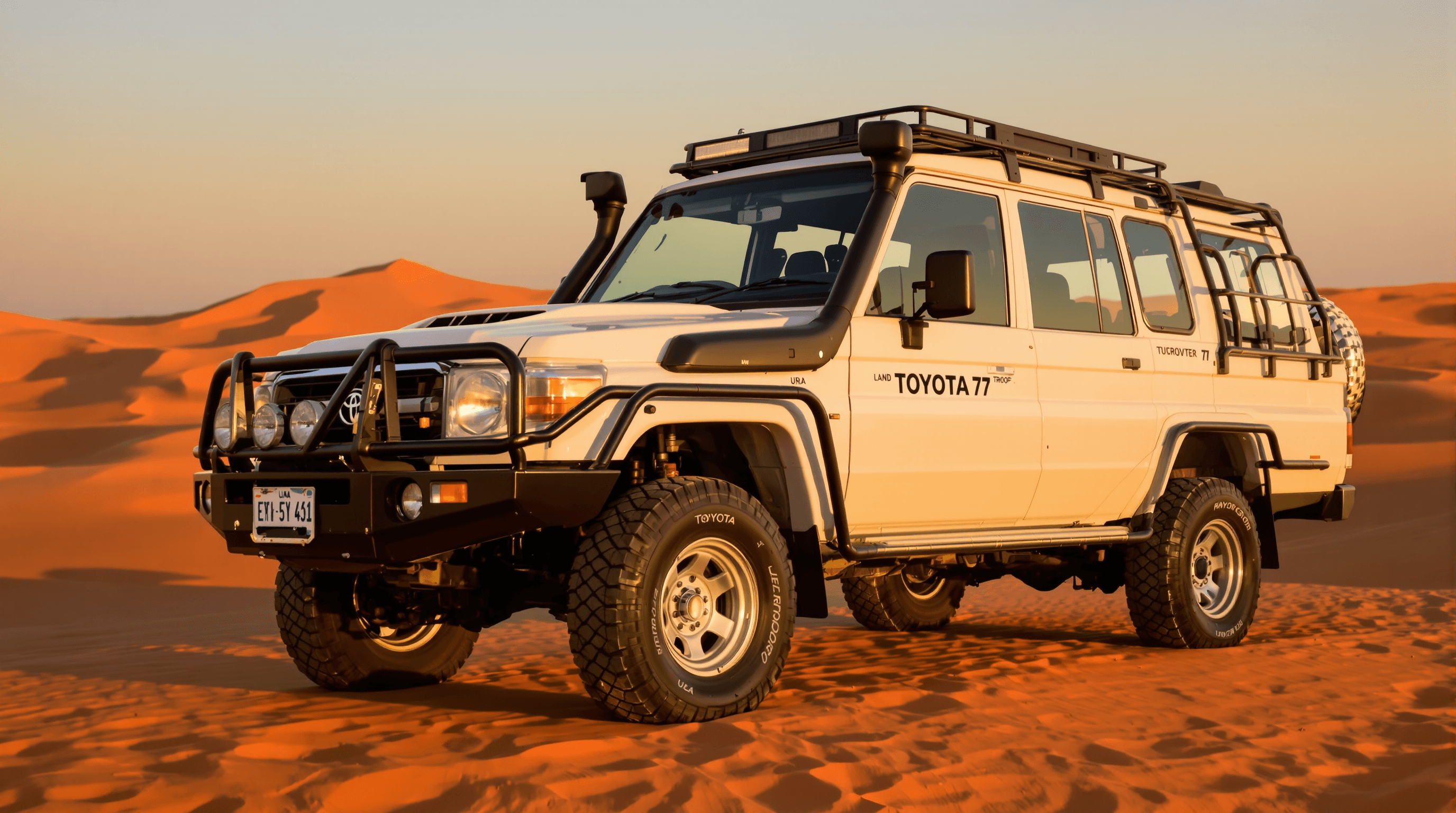
A basic two-to-three-inch lift is the usual entry point, and for good reason. Done properly it improves your approach and departure angles and makes room for slightly bigger tyres without the instability you get from going taller too soon. Pair it with a good set of all-terrain tyres and you'll notice the difference immediately on loose surfaces.
The part people skip is the shocks. Moving off the OEM units to a quality aftermarket set does more for how the car feels over rough ground than the lift itself — better wheel travel, far less crashing through bumps. And if you fit a lift, fit extended brake lines to match. A lifted suspension can stretch a standard brake line past its limit, and that's not something you want to discover on a steep wadi descent.
Things to get right at this stage:
- A quality two-to-three-inch lift matched to your specific vehicle
- Aftermarket shocks rather than the OEM units
- All-terrain tyres sized appropriately for the lift
- Extended brake lines to suit the new travel
- A proper alignment afterwards to fix the steering geometry
Stage two: where the real capability comes from
By now you've got a good number of trips behind you and you're tackling proper technical terrain — steeper faces, off-camber rock, soft crossings that punish clumsy throttle.
A longer-travel suspension setup unlocks real articulation and a more planted feel at speed. This is usually a taller lift with proper control arms and adjustable links rather than just spacers, and it changes the car's manners noticeably through fast desert sweeps.
But the single biggest capability jump most people ever make is fitting a locking differential. An open diff sends power to the wheel with the least grip — exactly the wrong one when you've got a tyre in the air. A locker forces both wheels on an axle to turn together, and the number of "stuck" situations it simply walks you out of is hard to overstate. Combine lockers with the extra travel from your suspension and a lot of the obstacles that used to stop you stop being obstacles.
Get this stage done by someone who knows what they're doing — suspension and steering geometry is not where you want to improvise. The garages directory lists workshops that handle this sort of work.
Worth prioritising here:
- A longer-travel suspension setup with proper control arms for your platform
- Front and/or rear locking differentials (air or electronic)
- Heavy-duty steering components to cope with the bigger tyres and travel
- Skid plates for the transfer case, fuel tank and diff covers
- Recovery gear you actually know how to use, and a winch rated well above your vehicle's weight
Stage three: the serious end
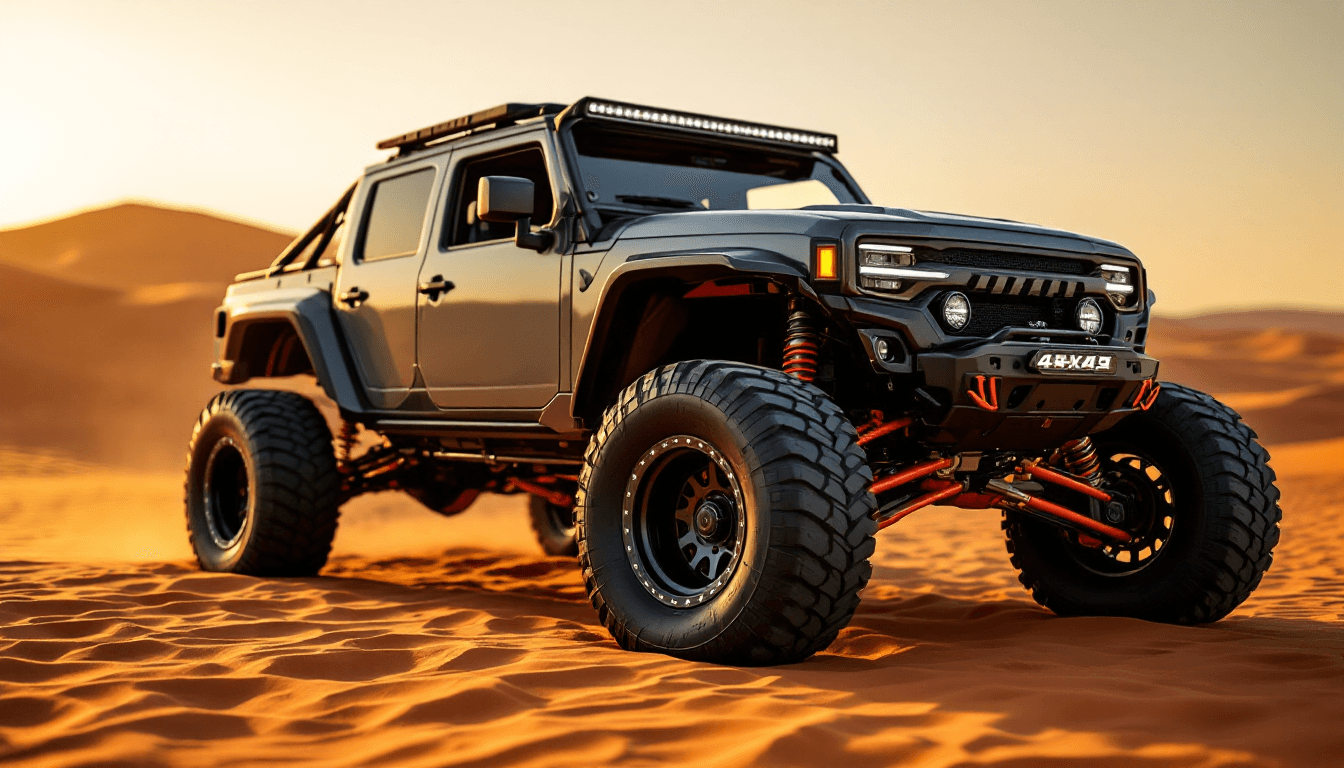
This is the purpose-built expedition territory, and honestly most people never need it. It's for drivers with years of consistent experience and a real understanding of how their vehicle behaves at the limit.
At this level you're into adjustable, remote-reservoir coilovers that let you tune compression and rebound for everything from high-speed sand to slow technical crawling. Portal axles come into the conversation — they buy you significant extra ground clearance without the top-heavy feel of going taller on the springs — though they're a major commitment in cost and complexity. Auxiliary fuel systems for genuine multi-day range into remote desert also live here.
My honest advice: don't build to this level on paper. Do several guided multi-day trips first. The terrain those trips put you through will teach you what you actually need far better than a spec sheet, and you'll spend your money on the right things.
Tyres and pressure tie it all together
Your tyres are the only thing touching the sand, so they matter at every stage. The biggest single gain available to you costs nothing: airing down. Dropping pressure on soft sand spreads the contact patch and transforms how the car floats over it. I run lower than most newcomers expect and it makes a far bigger difference than another modification ever will.
The catch is sidewall strength. When you air down, a weak sidewall can fold under hard cornering load, and that's how tyres come off rims. If you're driving the dunes regularly, tougher load-range tyres are worth the money — they survive airing-down abuse far better than budget rubber.
One thing that's easy to overlook: wheel offset has to suit your suspension. Get it wrong and you'll introduce steering vibration and chew through wheel bearings, and no amount of suspension tuning will fix it. When you're choosing wheels, talk to someone who'll match the offset and load rating to your actual setup.
For the detail on getting pressures right, read tyre pressure for sand in the UAE.
Build with people, not just parts
You learn faster in company. Driving with a group puts you next to people running every kind of setup, watching how they read terrain, and getting pulled out (or doing the pulling) when things go wrong. No video replaces sitting in a convoy with someone more experienced talking you through a line.
It's also the best way to see what each build stage actually demands before you spend the money. Watch a properly built rig work a hard section and you'll understand exactly what skill it takes to drive one. The clubs directory is a good place to find a group near you.
A note on timing and budget
Choosing when to make each upgrade matters as much as choosing the parts. The trap is always the same — capability outrunning skill — so it's worth getting an experienced eye on your plan before you commit to anything major.
New geometry changes how a car behaves, sometimes in ways that catch out even experienced drivers. After a big suspension change, give yourself time on familiar terrain to recalibrate before you go pushing into anything serious. The vehicle you got out of last weekend is not the vehicle you'll get into after the work is done.
If you're right at the start of all this, the most useful thing you can do before spending anything is learn the car as it came — book a session or a course and get the fundamentals down on a stock vehicle first.
A few common questions
What's the best first suspension upgrade? A modest two-to-three-inch lift with good aftermarket shocks and extended brake lines. It adds real capability without the instability of going tall, and it's an honest first step rather than an overreach.
When am I ready to move from stage one to stage two? When you can consistently handle varied terrain — controlled descents, smooth throttle on loose ground, and self-recovering from a stuck without help. If you're still getting regularly stuck on terrain you've driven before, more hardware won't fix that yet.
Do I actually need locking differentials? Not for casual dune drives on well-travelled routes. But the moment you start exploring steeper faces and remote terrain where getting stranded is a real risk, a locker earns its keep faster than almost anything else you can fit.
Reviewed by experienced desert drivers. Our team personally visits operators and tests courses across the UAE.
Explore the Directory
Find off-road clubs, courses, garages and events across Dubai & UAE.
View Directory →