Letting Your Tyres Down for Desert Driving
How low to air down for UAE sand, how to do it safely, and how to get back to road pressure without wrecking your tyres.

Letting Your Tyres Down for Desert Driving
If you only ever learn one thing about driving in the desert, make it this one. More first-time drivers get stuck because they didn't air down enough than for any other reason. You can have the right car, decent tyres and a sensible line, and still bury yourself to the axles in soft sand simply because you left your tyres at road pressure.
The reason is simple. At road pressure your tyre is hard and narrow, and in soft sand it digs in like a knife. Let some air out and the tyre flattens and spreads, so it floats across the surface instead of cutting down into it. You don't need to memorise any physics. You just need to remember that softer tyres float and hard tyres sink.
How low to go
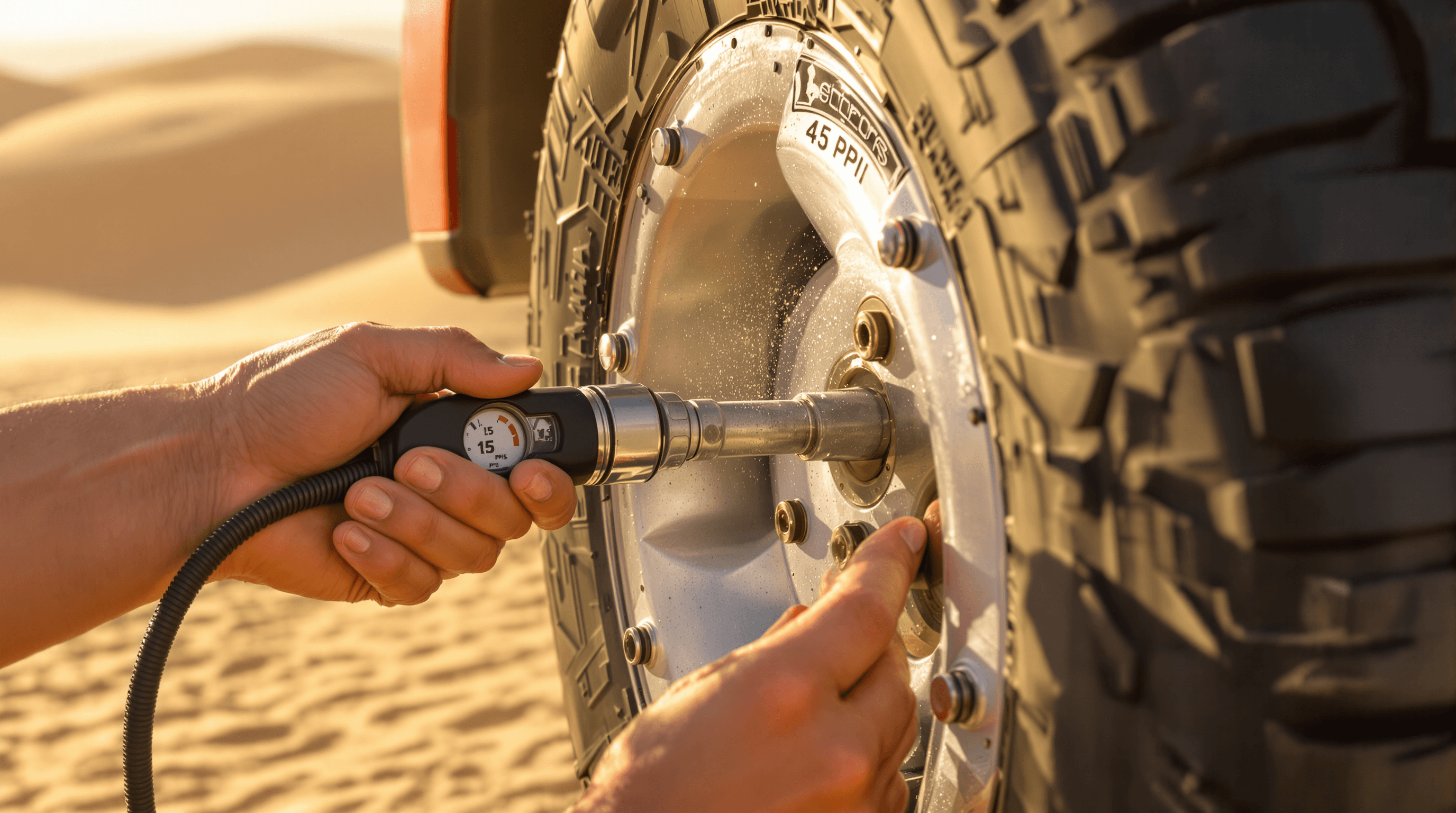
There's no single magic number, because it depends on your vehicle's weight, your tyres, and how soft the sand is on the day. But for most full-size 4x4s in UAE dunes, somewhere around 15 PSI is a sensible starting point. If you're still struggling in soft stuff, drop further. Lighter vehicles can usually go a little lower than heavy ones.
A rough way to think about it:
- Heavy SUVs (Land Cruiser, Patrol): start around 15-18 and drop toward 12-14 for soft sand
- Mid-size 4x4s (Prado, Wrangler): start around 14-16, lower for soft
- Light vehicles (Jimny): can run a bit lower again
These are starting points, not rules. The honest answer is you adjust by feel. If the car is ploughing and bogging, you're too high. Let more out. If you're banging the rims or the tyre feels like it's rolling on the wheel in turns, you've gone too far.
The big risk of going too low is rolling the tyre off the rim, usually in a hard turn or a sharp impact. That ends your day fast. So drop in stages, test, and don't chase the absolute lowest number you can get away with.
Doing it safely
Air down before you hit the sand, not once you're already stuck in it. Find a flat spot at the edge of the desert, do all four tyres, and only then drive in.
You need two things: a way to let air out, and a reliable gauge to know where you are. A simple valve-core tool works fine and is cheap. Automatic deflators that screw onto the valve and stop at a set pressure are a nice convenience if you're out often. Either way, check each tyre with a proper gauge afterwards rather than trusting it blind.
Don't go in without a way to air back up. A 12V compressor is not optional kit out here. If you're driving with a group, at least make sure someone in the convoy has one.
Reading the sand
Conditions change a lot over short distances in the UAE. Powdery, fine sand with no tracks in it is the soft stuff that swallows cars, and that's when you want to be on the lower end of your range and keep your momentum up. Packed sand that holds tyre prints is much more forgiving and you can run a touch firmer.
Where there's rock mixed in with the sand, like the harder ground around Fossil Rock, ease back up a little. Very low pressure over sharp rock is how sidewalls get cut. Higher pressure there protects the tyre.
Plenty of experienced drivers keep a gauge in the door pocket and tweak through the day as the terrain changes. You don't have to be precious about it, but a few PSI either way genuinely matters.
Getting back to road pressure
This is the part people forget once they're tired and heading home. Driving on the tarmac at sand pressures is dangerous. Soft tyres at highway speed build up huge amounts of heat, and a blowout at 100 km/h is a real way to ruin more than your day.
Air all four back up to road pressure before you get on the highway. If you don't have a compressor with you, get them up enough to crawl slowly to the nearest petrol station with a working air pump and finish there. Before you reinflate, brush the sand off the valve stems so grit doesn't jam the valve open.
Build the time into your plan. Airing four tyres back up takes a while, especially with a small compressor, so don't leave it until you're already running late.
A few honest mistakes to avoid
Not airing down enough is the classic one, and it's the most common cause of getting stuck. The opposite mistake, going far too low chasing flotation, is what pops tyres off rims. And forgetting to air back up before the road is the one that's actually dangerous rather than just annoying.
If you're new to all this, the cheapest way to learn the feel for it is alongside people who already have it. The courses listed on the site cover airing down properly as part of a first desert session, and an afternoon with an instructor will teach you more about reading sand than any number of articles.
A few common questions
What pressure should I run for soft dunes? For most full-size 4x4s, somewhere around 12-15 PSI is a good working range for soft sand. Start higher, drop if you're struggling, and stop if the tyre feels like it's moving on the rim.
Can I drive on the road at sand pressure? No. Get back up to road pressure, or close to it, before any highway driving. Low pressure at speed overheats the tyre and can cause it to fail.
Do front and rear need different pressures? For most vehicles, running the same front and rear is fine. If you're carrying a lot of weight or gear in the back, a little more in the rear doesn't hurt.
Reviewed by experienced desert drivers. Our team personally visits operators and tests courses across the UAE.
Shop 4x4 Gear & Accessories
Recovery gear, winches, tyres and accessories from top UAE shops.
View Directory →