Setting Up a Winch for UAE Desert Driving
A practical guide to choosing, mounting and maintaining a winch for off-road recovery in the UAE desert — and why it's often not the first tool you reach for.
Setting Up a Winch for UAE Desert Driving
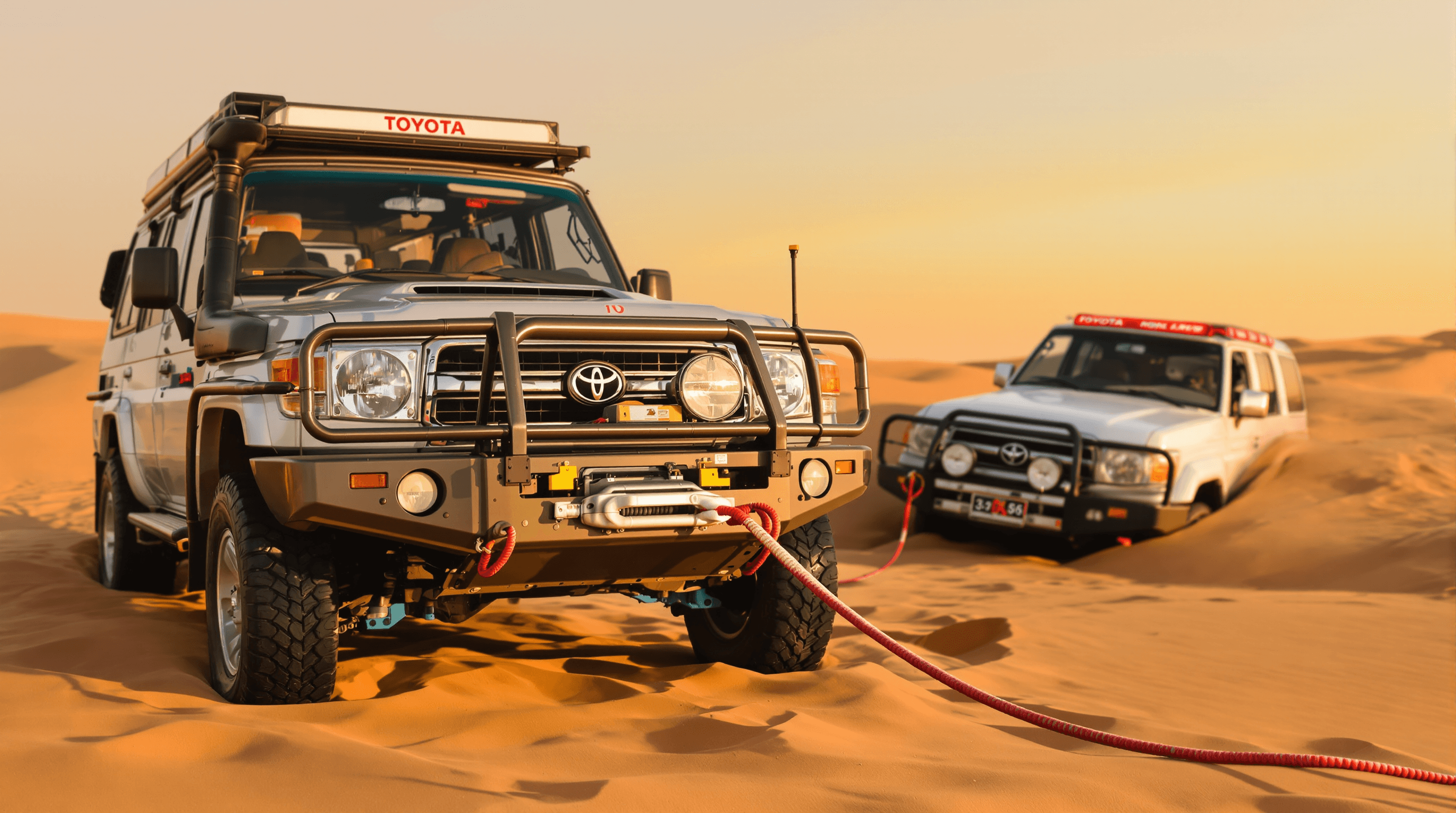
Here's the first thing worth saying about winches in the dunes: most of the time you won't use one. When a car is buried in soft sand, the fastest, safest fix is usually dropping tyre pressures, digging the wheels clear, and a gentle pull from a mate on a snatch strap. A winch earns its keep when there's nothing solid to pull against, when you need slow and precise control, or when a kinetic pull would risk bending something. On a sabkha crust or a steep rocky climb in the mountains, that's exactly the situation you get into. So a winch is worth having — just don't expect it to be your everyday recovery tool out here.
If you do fit one, the desert puts its own demands on the setup. Fine sand gets into everything, summer heat is brutal, and you may be a long way from help. That changes a few of the choices you'd make elsewhere.
Electric or hydraulic
The vast majority of winches you'll see on UAE trucks are 12V electric units. They're simpler to fit, easier to live with, and they run off your existing battery and alternator. The downside is duty cycle — pull hard for too long and the motor heats up, so you work in short bursts and let it cool.
Hydraulic winches run off the power steering pump and can pull continuously without draining the battery, which is genuinely useful on long, heavy recoveries. But they're a more involved install and overkill for most weekend driving. For nearly everyone reading this, electric is the right answer.
Synthetic rope vs steel cable
If you're buying new, go synthetic. Synthetic line is much lighter to handle, and — the part that matters for safety — it doesn't store nearly as much energy as steel cable. When a steel cable snaps under load it whips back hard enough to kill; synthetic line tends to drop. It's also kinder on your hands and easier to re-spool cleanly by yourself.
The trade-off is that synthetic line doesn't love sand grinding into the fibres, or constant UV. So you wash it, you keep it covered when you can, and you inspect it. More on that below.
Mounting
A winch only pulls as hard as what it's bolted to. That means a proper steel bull bar or a dedicated winch mount rated for the loads — a standard plastic bumper will not hold a winch under recovery tension, full stop. Plenty of Dubai workshops will sell and fit the bar, mount, winch and wiring as a package, which is the sensible route unless you really know what you're doing with the electrics. The garages directory is a good place to start looking.
A couple of details that matter in our conditions:
- Pick the right fairlead for your line — an aluminium hawse fairlead for synthetic rope, a roller fairlead for steel cable.
- Leave the motor some airflow. Heat is the enemy here, and the more it can breathe the longer it lasts.
- Watch your approach angle. A big bar and winch hanging off the front can cost you clearance on steep dune faces.
Power and wiring
Winch motors pull a lot of current, so the wiring has to be up to it — heavy-gauge cable, proper fusing, and good clean connections. This is where a lot of cheap installs come undone: corroded or loose terminals get hot and let you down at the worst moment, so use quality connectors and protect them.
You don't strictly need a dual-battery setup for the odd recovery, but if you winch regularly, run a fridge, or do longer trips, a second battery is worth it — it stops a long pull leaving you unable to start the car. An uprated alternator helps too, since a stock one on a Prado or Patrol can struggle to keep up with sustained winching. If you're going down that road, our dual battery setup guide covers it in more detail.
Anchoring in sand
The hardest part of winching in the desert is finding something to pull against. Out in the dunes there are no trees and no rocks. The usual answer is a dedicated sand anchor — a buried plate or a purpose-made device like a Pull-Pal that digs in as you load it. Some people bury a spare tyre as a deadman. Whatever you use, set it well back from the stuck vehicle and never trust a scraggly bush or a loose boulder to hold.
When you do have a recovery point — a tree in the wadis, another vehicle, solid rock — protect it with a proper strap and use rated shackles. And before you pull, lay a heavy bag or blanket over the middle of the line. If anything lets go, the dampener kills the rebound. That one habit is cheap insurance.
Recovery gear that goes with it
A winch on its own doesn't do much. The kit that makes it useful:
- Rated shackles or soft shackles sized for your winch's capacity — cheap hardware fails dangerously, so buy from a known brand.
- A tree/anchor protector strap.
- A snatch block (or pulley), which lets you double your pulling power or change the direction of a pull.
- A line dampener.
- Decent gloves.
Buy the shackles and straps from somewhere that can tell you the actual rated capacity, not just whatever's cheapest. The gear directory lists suppliers, and it's worth pairing any winch with the rest of a sensible recovery kit.
Looking after it in the desert
Sand and sun are what kill winches here, so a little routine goes a long way. After a sandy trip, blow the sand out of the motor and fairlead with compressed air and check nothing's packed in around the cooling. Give synthetic line a rinse with fresh water to get the grit out of the fibres, and keep it out of direct sun when you're not using it — UV degrades it over time, so inspect for fraying and chafe and don't be sentimental about replacing a tired rope.
Beyond that, keep the electrical connections clean and protected, and don't ignore the gearbox — it wants its oil changed on schedule like anything else. A winch that sits neglected for a year is exactly the winch that won't pull when you finally need it.
Get some practice in
Winching is one of those things that looks simple on YouTube and gets complicated fast when you're tired, the light's going, and a car's buried to the chassis. Rigging anchors, using a snatch block for mechanical advantage, keeping everyone clear of a loaded line — it's all much easier once someone has shown you in person. A recovery or off-road course is genuinely worth it before you rely on the gear for real; the courses directory lists providers that cover hands-on recovery.
FAQ
What winch capacity do I need? The usual rule of thumb is roughly 1.5 times your vehicle's loaded weight, so for a typical UAE 4x4 most people end up on an 8,000–12,000 lb unit. Err on the larger side — a winch working near its limit gets hot and slow, and the bigger one pulls easier.
Synthetic rope or steel cable? Synthetic, for most people. It's lighter, safer if it fails, and easier to handle. You just have to keep it clean and out of the sun.
Do I really need a winch for desert driving? For dune driving, often not — a snatch strap and a shovel handle the great majority of stucks. A winch comes into its own in rocky terrain, on crusty sabkha, or when there's nothing to pull against and you need slow, controlled recovery.
Reviewed by experienced desert drivers. Our team personally visits operators and tests courses across the UAE.
Explore the Directory
Find off-road clubs, courses, garages and events across Dubai & UAE.
View Directory →