Choosing Off-Road Tyres for the UAE Desert
A practical guide to picking 4x4 tyres for Dubai conditions: all-terrain vs mud-terrain, sizing for popular UAE 4x4s, and what to know before you buy.

Choosing Off-Road Tyres for the UAE Desert
If you only ever change one thing on a 4x4, make it the tyres. You can spend a fortune on lifts and lockers, but in the sand it's the rubber doing most of the work — and a good set on a stock car will get you further than a poor set on a heavily modified one. The trouble is that "off-road tyre" covers everything from highway-friendly all-terrains to aggressive mud-terrains that have no business on Sheikh Zayed Road, so it's worth understanding what you're actually buying.
All-terrain, mud-terrain or sand
For most people in the UAE, the answer is all-terrain (A/T). These are the tyres you see on the majority of weekend dune cars: enough shoulder lug and sidewall bite to handle soft sand and the odd rocky wadi, while still being quiet and long-lasting enough to commute on during the week. Sizes like 265/65R17 and 285/70R17 are common fitments. If you split your time between the highway and the desert — which is nearly everyone here — an A/T is the sensible default.
Mud-terrains (M/T) have deeper, more widely spaced tread blocks and stiffer sidewalls. They shine on rock and technical terrain like Fossil Rock or the Hatta trails, where you want grip and puncture resistance more than refinement. The trade-off is real: they're noisier, wear faster on tarmac and tend to cost you a little fuel economy. Unless a lot of your driving is rocky, an M/T is more tyre than you need for UAE dunes.
Dedicated sand tyres — wide, smooth-ish, built purely for floatation — exist, but they're a specialist toy for people who do nothing but dunes. They're miserable in the wet and chew up quickly on the road, so they're not a daily-driver option.
A few brands have earned a long reputation in this climate for heat tolerance and toughness — BFGoodrich's All-Terrain T/A KO2, Cooper's AT3 range, Toyo Open Country and Falken Wildpeak all come up constantly in UAE off-road circles. Any of them in a quality A/T is a safe starting point. Beyond that, talk to people who run them; word of mouth from a club is worth more than any spec sheet.
Getting the size right
Most UAE-market 4x4s — Land Cruiser 200/300, Patrol Y62, Wrangler, Prado — will take a 33-inch tyre (roughly 285/70R17) without any modification. That's the sweet spot for added clearance and float without forcing you into a lift, fender trimming or a speedo recalibration.
Going up to 35s is where it gets involved: you're usually looking at suspension and clearance work, and a speedometer that now reads slow. The other thing people forget is sidewall. Dropping to a lower-profile tyre on a bigger wheel (say a 20-inch rim) looks the part on the road but gives you less sidewall to flex and protect the rim when you air down — not what you want in rocky terrain.
A useful rule: keep your overall tyre diameter close to stock unless you're prepared to address the knock-on effects. If you're planning a bigger jump, a garage that does a lot of 4x4 work will tell you honestly what your specific vehicle needs.
Pressure matters more than the tyre
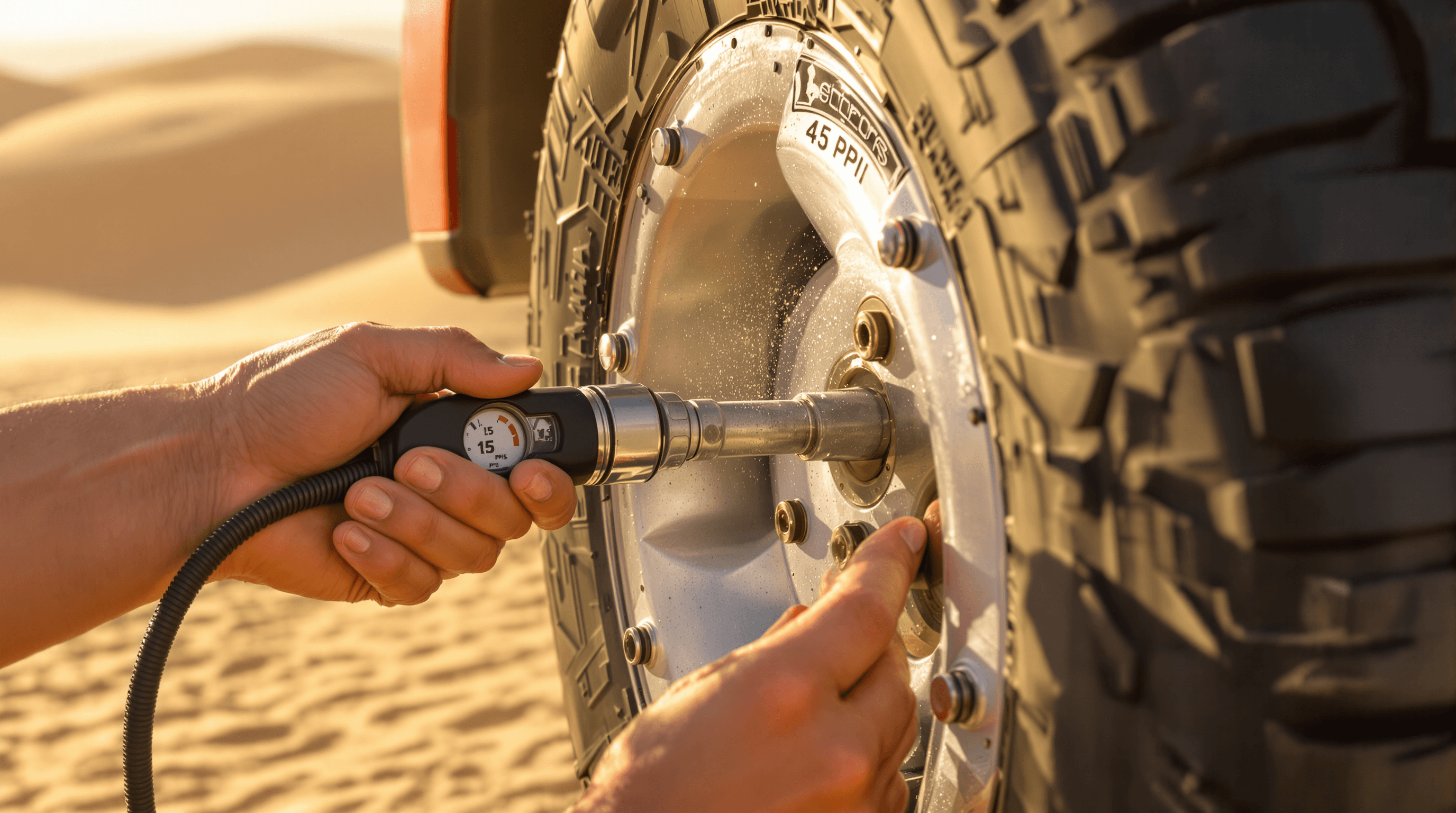
Whatever you fit, the single biggest performance change in sand comes from airing down. A good A/T at the right pressure will float across soft sand that the same tyre, at road pressure, would dig straight into.
As a rough starting point, most people run somewhere around 12–18 PSI for sand on a standard passenger 4x4, and come back up toward 20–25 PSI for rocky ground where you need to protect the sidewalls. Heavier vehicles and bigger tyres behave differently, so treat those as starting figures and adjust to how the car is actually behaving — and always air back up before you hit the road. It's worth carrying a decent compressor and reading up properly on tyre pressure for sand before your first proper desert run.
Buying and fitting
Tyres are stocked everywhere in Dubai, from brand showrooms to the cluster of independent shops out in places like Al Quoz. Showroom fitting tends to cost more but comes with warranties and proper after-sales support; independents are cheaper and often more clued-up on modified setups, but quality varies, so ask around first. The gear directory lists suppliers if you want a starting point.
Wherever you buy, get the tyres properly mounted and balanced on equipment built for heavy 4x4 tyres, and have an alignment done after any size change — bad alignment quietly eats tread and traction. One small upgrade worth doing while the tyres are off: heavier-duty valve stems, since the cheap stock ones take a beating from repeated airing down and up.
Looking after them in this climate
UAE heat and UV are hard on rubber. Tyres parked out in the sun all day will crack at the sidewall long before they wear out, so covered parking or a cover on the spare helps. Check your pressures cold and keep an eye on them through the seasons — air pressure rises and falls with temperature, and the swing here is significant. Rotate them periodically to keep wear even, especially since off-road use tends to punish certain positions harder.
A few common questions
What size can I fit without modifying anything? On most UAE 4x4s, a 33-inch tyre (around 285/70R17) bolts on with no other changes. Bigger than that and you're usually into lift, trimming and speedo territory.
Should I run different tyres in summer and winter? No. Unlike colder climates, there's no real case for a seasonal tyre swap here — a good year-round A/T handles everything the UAE throws at it.
Can I mix brands or tread patterns? Best avoided, especially on the same axle. Different rolling diameters put strain on the drivetrain and confuse traction systems. Replace in pairs at minimum, ideally as a full set.
Reviewed by experienced desert drivers. Our team personally visits operators and tests courses across the UAE.
Shop 4x4 Gear & Accessories
Recovery gear, winches, tyres and accessories from top UAE shops.
View Directory →