Off Road Convoy Rules UAE 2026: Essential Safety Guide
Complete guide to UAE off road convoy rules, safety protocols, and legal requirements. Learn proper communication, spacing, and emergency procedures for desert driving.

Off Road Convoy Rules UAE: Complete Safety and Legal Guide for Desert Adventures
Off road convoy UAE operations require strict adherence to safety protocols and communication standards to ensure every participant returns safely from desert adventures. Understanding proper convoy procedures can prevent accidents, reduce rescue incidents, and create enjoyable experiences for all skill levels.
Desert driving in groups presents unique challenges including limited mobile coverage, extreme weather conditions, and terrain variations that can separate vehicles quickly. This comprehensive guide covers essential convoy rules, communication protocols, and legal requirements specific to UAE off-road environments.
Essential UAE Off Road Convoy Communication Protocols
Every convoy must establish clear communication channels before entering desert areas. UHF radios remain the primary communication method, with Channel 40 (477.400 MHz) serving as the standard UAE off-road frequency. Mobile phone coverage becomes unreliable beyond 20km from major highways.
Radio discipline ensures critical messages reach all participants:
- Keep transmissions brief and clear
- Use vehicle call signs or driver names
- Wait for channel clearance before transmitting
- Maintain radio contact every 15-20 minutes during travel
WhatsApp location sharing serves as backup communication when cellular coverage exists. Create a group chat including all participants and share live locations at regular intervals. Download offline maps through Google Maps or specialized apps like Gaia GPS before departure.
Emergency communication requires satellite devices for remote areas. Personal locator beacons (PLBs) or satellite messengers provide rescue coordination when radio and cellular systems fail. Consider these essential equipment for convoys exceeding 50km from populated areas.
Vehicle Spacing and Formation Rules for Desert Driving
Maintain 100-150 meter spacing between vehicles in sandy terrain to prevent dust clouds from obscuring visibility. This distance allows adequate reaction time for sudden stops or navigation changes while keeping the convoy visible as a group.
Lead vehicle responsibilities include route selection and pace management:
- Navigate at the slowest participant's skill level
- Stop immediately when rear vehicles fall behind
- Choose appropriate routes for convoy capability levels
- Communicate obstacles and terrain changes via radio
Tail vehicle duties ensure no participants get left behind:
- Monitor convoy integrity and spacing
- Report mechanical issues or stuck vehicles
- Carry additional recovery equipment
- Maintain radio contact with convoy leader
Formation adjustments adapt to terrain conditions. Single-file formation works best for narrow tracks and technical sections. Parallel formation allows faster travel across open desert areas while maintaining visual contact between vehicles.
Check our safety courses directory for comprehensive convoy leadership training programs available in Dubai and Abu Dhabi.
Legal Requirements and Permits for UAE Desert Convoys
UAE off road convoy operations must comply with federal traffic laws and emirate-specific regulations. Groups of 5+ vehicles require advance notification to relevant authorities, particularly when crossing emirate boundaries or accessing protected areas.
Required documentation includes:
- Valid UAE driving licenses for all participants
- Vehicle registration and insurance papers
- Comprehensive insurance covering off-road activities
- Emergency contact information for each participant
Protected area restrictions apply to numerous UAE locations. Dubai Municipality requires permits for large group activities in Al Marmoom Desert Conservation Reserve. Abu Dhabi's Environment Agency regulates access to Liwa Oasis and surrounding dune systems.
Emirates-specific regulations vary significantly:
- Dubai: Groups exceeding 10 vehicles need tourism permits
- Abu Dhabi: Archaeological site proximity restrictions
- Sharjah: Wildlife reserve access limitations
- Ras Al Khaimah: Mountain access requires local guide certification
Insurance considerations become critical for convoy organizers. Standard vehicle insurance may exclude off-road activities, requiring specialized coverage through providers familiar with UAE desert driving requirements. Learn more about 4x4 off-road insurance options before organizing group trips.
Safety Equipment and Recovery Protocols
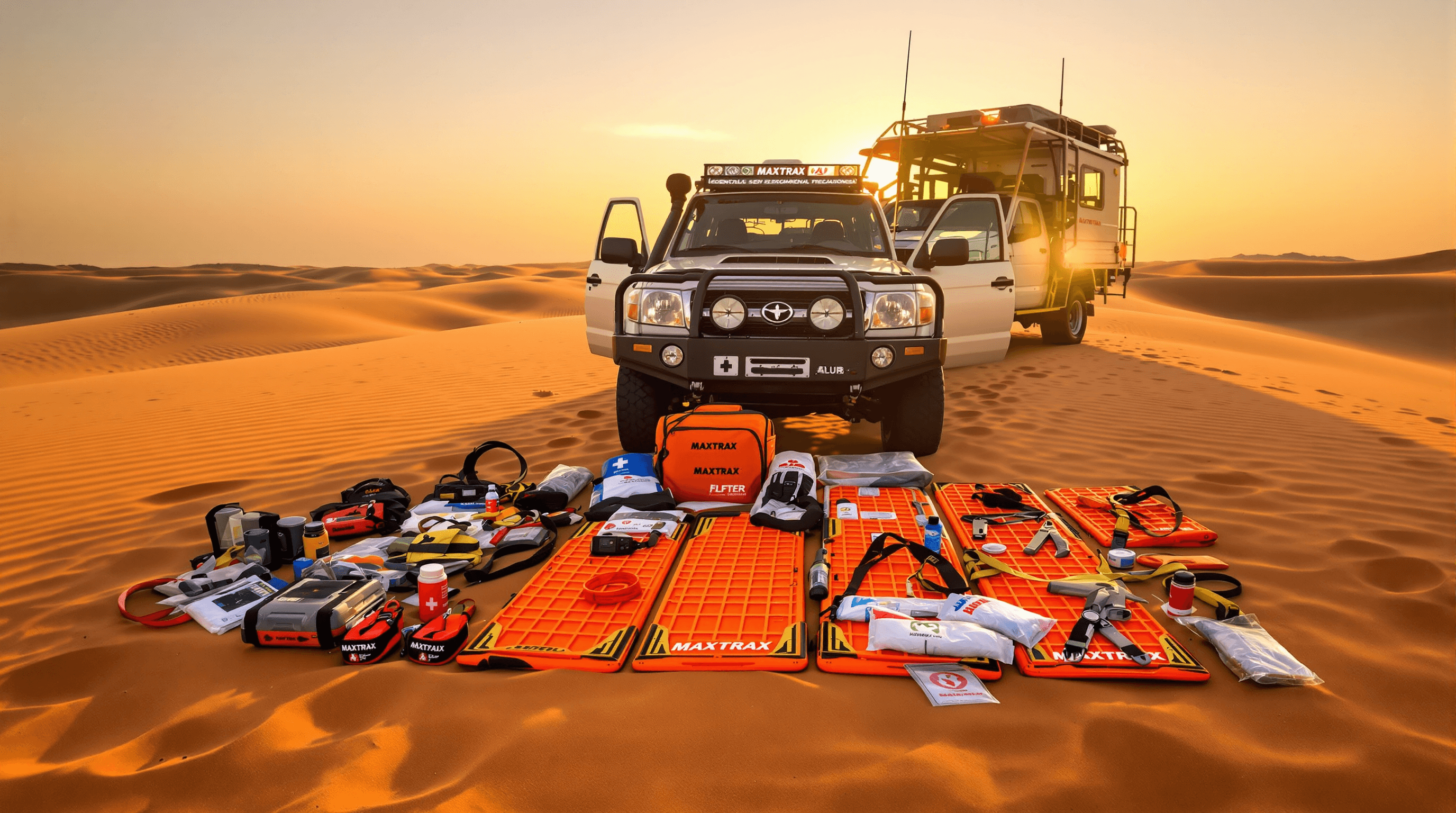
Every convoy vehicle must carry mandatory safety equipment including first aid kits, minimum 10 liters emergency water, emergency food supplies, and basic recovery gear. Sand ladders or traction aids prevent most stuck vehicle situations in desert conditions.
Convoy-level equipment distribution ensures redundancy:
- Lead vehicle: GPS navigation, detailed route maps
- Multiple vehicles: UHF radios, recovery straps
- Designated support vehicle: Comprehensive first aid, mechanical tools
- All vehicles: Emergency shelter, signaling devices
Recovery procedures follow established protocols to prevent injury during stuck vehicle operations. Position vehicles upwind from recovery operations, engage parking brakes, and ensure all personnel stand clear of recovery equipment under tension.
Emergency response plans address medical and mechanical situations. Designate participants with first aid training, establish evacuation procedures, and maintain emergency contact lists including location coordinates for rescue services.
Medical emergencies require immediate convoy response. Serious injuries necessitate Dubai Emergency (999) or Abu Dhabi Police (999) contact, with precise GPS coordinates and injury descriptions. Learn essential desert driving safety protocols through professional training programs.
Navigation and Route Planning for Group Desert Trips
Pre-trip route planning prevents convoy separation and ensures appropriate difficulty levels for all participants. Share detailed route maps, waypoint coordinates, and estimated travel times before departure day.
Navigation responsibilities include:
- Primary navigator in lead vehicle with GPS and backup maps
- Secondary navigator in convoy for verification
- Predetermined rally points every 10-15km
- Alternative route options for weather or terrain changes
Digital navigation tools complement traditional map reading. Download offline maps covering entire route areas, mark water sources and fuel stops, and identify mobile coverage zones for emergency communications.
Weather monitoring affects route safety significantly. UAE meteorological services provide desert-specific forecasts including visibility, wind speeds, and temperature extremes. Cancel or modify routes when conditions exceed convoy capability levels.
Rally points serve as regrouping locations for separated vehicles. Choose distinctive landmarks visible from multiple directions, with adequate space for entire convoy assembly. Communicate rally point coordinates via radio before departing each location.
Explore proven routes through our guide to Al Qudra desert driving and Fossil Rock adventures for convoy-friendly destinations near Dubai.
Emergency Procedures and Incident Response
Immediate response protocols address common desert emergency situations including vehicle breakdowns, medical incidents, severe weather, and navigation errors. Every participant must understand basic emergency procedures before convoy departure.
Medical emergency response follows structured priorities:
- Secure scene safety and prevent additional injuries
- Provide immediate first aid within training limitations
- Establish emergency communication with rescue services
- Prepare landing zone for helicopter evacuation if required
Mechanical breakdown procedures minimize convoy delays while ensuring stranded vehicle recovery. Document breakdown locations with GPS coordinates, assess repair possibilities with available tools, and arrange towing or recovery equipment deployment.
Severe weather response includes sandstorm and flash flood protocols. Sandstorms require immediate shelter-in-place procedures with vehicles positioned to prevent sand infiltration. Flash flood risks affect wadi areas during winter months, requiring route modifications or expedition cancellation.
Lost vehicle procedures activate when convoy members separate beyond radio communication range. Establish search patterns, maintain position reporting schedules, and contact authorities when participants remain missing beyond predetermined timeframes.
Search and rescue coordination involves multiple UAE agencies. Dubai Police handle emirate-specific incidents while National Search and Rescue Committee coordinates multi-emirate operations. Provide accurate GPS coordinates, participant counts, and available resources when requesting assistance.
Review comprehensive recovery techniques and emergency gear recommendations to prepare for challenging situations.
Training and Skill Development for Convoy Leaders
Convoy leadership requires specialized training beyond individual off-road driving skills. Effective leaders understand group dynamics, risk management, emergency response, and UAE-specific regulations affecting desert operations.
Professional training programs cover:
- Advanced navigation and route planning
- UHF radio operation and emergency communications
- Vehicle recovery techniques and safety procedures
- First aid certification with wilderness emphasis
- UAE legal requirements and permit processes
Skill development progression starts with participation in established convoys before assuming leadership responsibilities. Observe experienced leaders, practice communication protocols, and develop mechanical troubleshooting capabilities through hands-on experience.
Mentorship opportunities exist through established UAE off-road communities. Join recognized clubs offering structured training programs, participate in organized events, and seek guidance from experienced desert drivers familiar with local conditions.
Continuing education addresses evolving safety standards and technology improvements. Annual refresher training, equipment updates, and regulation changes require ongoing attention from serious convoy organizers.
Access our clubs directory to connect with organizations offering convoy leadership development programs throughout the UAE.
Frequently Asked Questions
What radio frequency should UAE off road convoys use? Channel 40 (477.400 MHz) serves as the standard UAE off-road frequency. This UHF channel provides reliable communication in desert terrain and connects with established off-road communities throughout the Emirates.
How many vehicles require permits for UAE desert convoys? Groups of 5 or more vehicles typically require advance notification to authorities, while groups exceeding 10 vehicles need formal tourism permits in Dubai. Requirements vary by emirate and specific destination areas.
What safety equipment must every convoy vehicle carry? Mandatory equipment includes UHF radio, first aid kit, minimum 10 liters emergency water, basic food supplies, sand ladders or traction aids, emergency shelter, and signaling devices for rescue identification.
How far apart should vehicles travel in desert convoys? Maintain 100-150 meter spacing in sandy terrain to prevent dust cloud visibility issues while allowing adequate reaction time. Adjust spacing based on terrain conditions and convoy experience levels.
What insurance coverage do UAE off road convoys need? Comprehensive insurance specifically covering off-road activities is essential, as standard vehicle insurance often excludes desert driving. Convoy organizers should verify all participants carry appropriate coverage before departure.
When should convoys contact emergency services in the UAE? Contact Dubai Emergency (999) or Abu Dhabi Police (999) immediately for medical emergencies, missing participants beyond predetermined timeframes, or situations requiring professional rescue assistance. Provide precise GPS coordinates and detailed situation descriptions.
Reviewed by experienced desert drivers. Our team personally visits operators and tests courses across the UAE.
Explore the Directory
Find off-road clubs, courses, garages and events across Dubai & UAE.
View Directory →