4x4 Recovery Techniques UAE 2026: Complete Guide
Master essential 4x4 recovery techniques for UAE desert driving. Sand ladders, winching, and self-recovery methods from Dubai Offroad experts.
4x4 Recovery Techniques UAE 2026: Complete Guide
4x4 recovery techniques are essential skills for UAE desert driving, where soft sand and challenging terrain can strand even experienced drivers. Getting stuck in the desert is inevitable, but knowing proper recovery methods transforms a potential emergency into a manageable situation. This comprehensive guide covers proven recovery techniques specifically adapted for UAE conditions, from basic self-recovery to advanced winching operations.
The UAE's unique desert environment presents specific challenges that require specialized knowledge. Sand temperatures can exceed 60°C in summer, making metal recovery gear dangerously hot to handle. Remote locations mean professional help isn't readily available, making self-sufficiency critical for desert adventurers.
Whether you're exploring the vast dunes of Liwa or tackling the challenging routes around Al Faya, understanding 4x4 recovery techniques UAE conditions demand will keep you safe and mobile. Professional training through our courses directory provides hands-on experience with these essential skills.
Essential Recovery Gear for UAE Desert Conditions
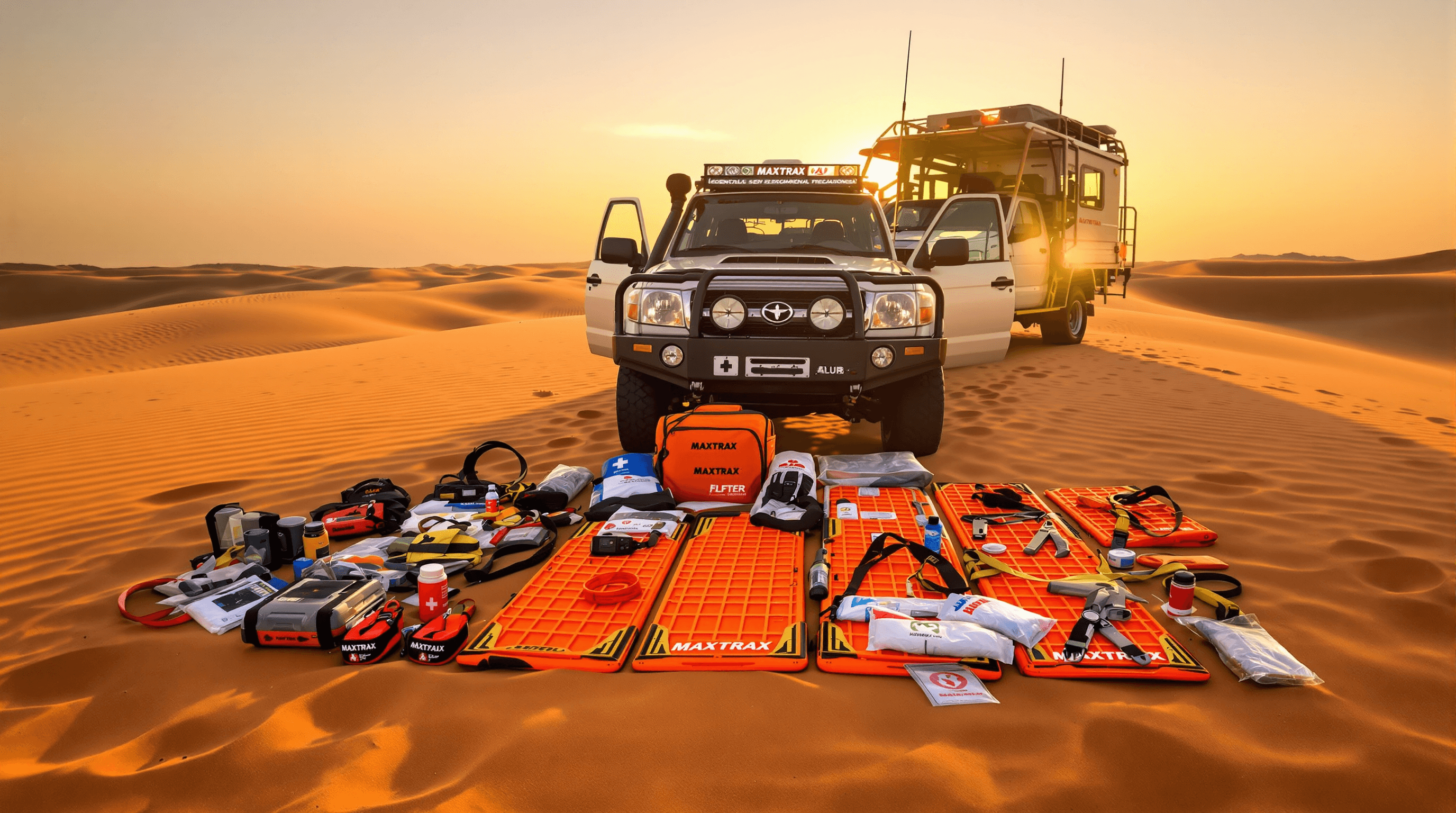
Every 4x4 operating in UAE deserts must carry specific recovery equipment rated for high temperatures and sand conditions. The extreme heat affects gear performance, with metal components becoming untouchable and synthetic materials degrading faster than in temperate climates.
Sand ladders remain the most versatile recovery tool for UAE conditions. Aluminum variants like Maxtrax handle sand better than steel alternatives, weighing 3.2kg per pair while supporting 9,000kg. Their bright orange color aids location in emergencies. Budget alternatives include Action Trax at AED 800 versus Maxtrax's AED 1,200 price point.
Recovery straps must be rated minimum 8,000kg breaking strength for full-size 4x4s. ARB and Warn manufacture heat-resistant polyester straps that maintain flexibility in 50°C+ temperatures. Standard tow ropes stretch dangerously under load and should never be used for recovery operations.
| Recovery Item | Weight (kg) | Capacity (kg) | UAE Price (AED) |
|---|---|---|---|
| Maxtrax Sand Ladders | 3.2 | 9,000 | 1,200 |
| ARB Recovery Strap 9m | 2.8 | 8,000 | 350 |
| High-Lift Jack | 13.6 | 2,270 | 800 |
| Tire Deflator | 0.2 | N/A | 120 |
Shovels require fiberglass or composite handles that won't burn hands in direct sunlight. Military surplus entrenching tools fold compact but full-size spades move sand faster during extended digging operations.
For comprehensive gear selection, review our detailed guide on recovery gear UAE options which covers climate-specific considerations and local supplier recommendations.
Tire Pressure Adjustment and Sand Ladders
Reducing tire pressure is the primary prevention technique that eliminates 70% of potential stuck situations in UAE sand conditions. Proper deflation increases tire contact patch from 150 square cm to over 400 square cm, dramatically improving flotation over soft sand.
Optimal sand pressures range from 0.8-1.2 bar (12-18 PSI) depending on vehicle weight and sand consistency. Heavy vehicles like Land Cruiser 200 series require lower pressures around 0.8 bar, while lighter Jeep Wranglers perform well at 1.0-1.2 bar. Monitor tire sidewall bulging to prevent rim damage on sharp rocks.
Digital tire deflators like the ARB E-Z Deflator (AED 120) provide precise pressure control essential for UAE conditions. Manual deflation through valve cores works but lacks accuracy needed for optimal performance. Carry a reliable 12V compressor rated minimum 150L/min for re-inflation, as detailed in our air compressor guide.
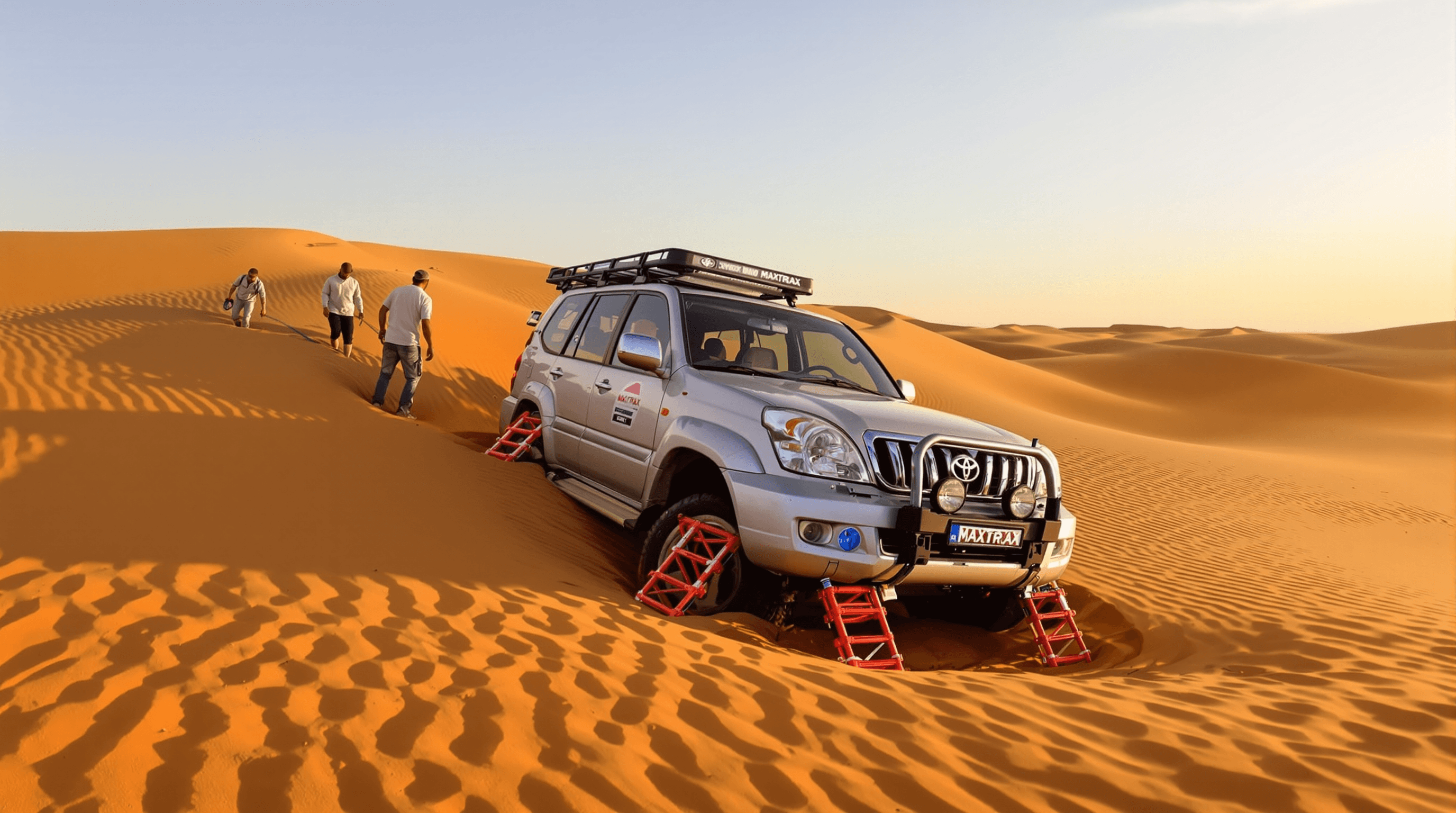
Sand ladder placement requires specific technique for UAE's fine sand conditions. Position ladders at 30-degree angles pointing toward desired direction, not straight under tires. Dig approach ramps 20cm deep to ensure tire contact. Modern composite ladders grip better than steel in fine Emirati sand.
Self-recovery sequence follows these steps:
- Stop immediately when wheels start spinning
- Assess stuck direction and required escape route
- Deflate to appropriate pressure if not done previously
- Clear sand from around tires using proper digging technique
- Position sand ladders with approach ramps
- Apply gentle throttle with steady momentum
The key principle for UAE sand recovery involves building momentum gradually rather than aggressive wheel spinning, which only digs deeper holes in the fine desert sand.
Winching Operations and Safety Protocols
Winch recovery provides the most reliable extraction method for severely stuck vehicles in UAE desert conditions, but requires strict safety protocols due to extreme forces involved. A typical Warn Zeon 10 winch generates 4,500kg pull force, creating deadly projectiles if cables snap under load.
Winch setup begins with proper anchor point selection. In UAE deserts, natural anchors are rare, requiring sand anchors or deadman anchors buried 60cm deep. Purpose-built sand anchors like the Bushranger Sand Anchor (AED 2,800) provide 3,600kg holding power when properly installed.
Cable management demands extreme caution in UAE's heat conditions. Steel winch cables become scalding hot, requiring heat-resistant gloves for handling. Synthetic Dyneema cables remain cooler but cost AED 1,500 versus AED 800 for steel alternatives. Both require cable dampeners positioned mid-span to contain energy if breakage occurs.
Safety zones must be established before winching begins:
- Primary danger zone: 1.5x cable length from winch and anchor
- Operator position: Behind solid barrier (vehicle body) minimum 45 degrees from cable line
- Spotter location: Outside danger zone with clear sight lines
- Bystanders: Minimum 30 meters from operation
Winching technique for UAE sand conditions requires steady, consistent pulls rather than shock loading. Engage winch in 3-meter increments, allowing motor cooling between pulls. Monitor amp draw to prevent overheating in 45°C+ ambient temperatures common during UAE summer months.
For advanced winching scenarios involving multiple vehicles, consult our comprehensive recovery guide which covers complex extraction procedures and team coordination protocols.
Team Recovery and Communication Procedures
Group recovery operations require clear communication protocols and defined roles to ensure safety during UAE desert expeditions. Multiple vehicles attempting simultaneous recovery create confusion and dangerous situations, particularly in remote areas where emergency services remain hours away.
Recovery team roles should be assigned before departures:
- Recovery Leader: Experienced operator directing all activities
- Spotter: Guides vehicle movement and monitors safety zones
- Equipment Manager: Handles gear setup and cable management
- Communications Officer: Maintains radio contact with convoy
Radio protocols using UHF CB radios on standard convoy frequencies ensure clear communication. Establish primary channel for recovery operations separate from general convoy chatter. Standard calls include "Clear to proceed," "Stop immediately," and "Emergency - all stop." Our convoy rules guide details communication procedures.
Buddy system recovery works effectively for moderate stuck situations involving two vehicles. Positioning requires the recovery vehicle at 45-degree angle to stuck vehicle, allowing proper departure angle after extraction. Never attempt recovery with vehicles directly inline, as this creates dangerous cable trajectories.
Multiple anchor points distribute loads during heavy recovery operations. UAE's soft sand often requires two or three vehicles as anchors, connected through equalizing straps that distribute forces evenly. This technique prevents anchor vehicles from being pulled into soft sand during extraction.
Documentation protocols should record GPS coordinates of stuck locations, recovery methods used, and time required for extraction. This data helps identify problematic areas and refine group skills for future expeditions. Share successful techniques through established off-road communities and our clubs directory.
Professional instruction in team recovery procedures is available through certified programs detailed in our desert driving course reviews.
Advanced Recovery Techniques for Severe Situations
Complex recovery situations in UAE deserts require advanced techniques beyond basic sand ladder and winch operations, particularly when vehicles become deeply embedded or positioned in dangerous attitudes. These scenarios demand specialized knowledge and equipment to prevent vehicle damage or operator injury.
High-lift jack operations provide vertical lifting capability essential for UAE desert recoveries. Hi-Lift X-Treme jacks (AED 800) lift 2,270kg through 1.5-meter travel, enabling tire changes in soft sand or chassis clearance for debris removal. Position jacks on solid base plates to prevent sinking in sand.
Jacking points on modern 4x4s require identification before expeditions. Land Cruiser 300 uses reinforced chassis points behind front wheels and ahead of rear axles. Jeep Wrangler provides dedicated jack points marked with arrows on chassis rails. Avoid using suspension components or body panels as jacking surfaces.
Compound recovery systems multiply winch pulling power through snatch blocks (pulleys), essential when single-line pulls prove insufficient. A double-line pull reduces winch load by 50% while doubling available force. Triple-line systems provide maximum mechanical advantage but require careful cable management.
Recovery calculations for UAE conditions:
- Single line: 100% winch capacity at 4,500kg
- Double line: 200% effective pull at 9,000kg
- Triple line: 300% effective pull at 13,500kg
- Cable length reduces proportionally with mechanical advantage
Dangerous situation protocols apply when vehicles approach rollover attitudes or occupy unstable positions. Immediate stabilization using sand bags, rocks, or additional vehicles prevents further movement. Never attempt recovery with occupants inside unstable vehicles.
Specialized equipment for severe recoveries includes:
- Kinetic recovery ropes for momentum-based extraction
- Ground anchors for situations lacking natural anchor points
- Cable extensions reaching distant anchor points
- Rigging plates distributing loads across multiple attachment points
Emergency extraction techniques require professional training available through advanced programs listed in our off-road driving lessons directory.
Prevention Strategies and Risk Assessment
Preventing recovery situations through proper route planning and vehicle preparation eliminates 80% of potential stuck scenarios in UAE desert conditions. Risk assessment begins during trip planning and continues throughout expeditions, with environmental factors playing crucial roles in navigation decisions.
Route reconnaissance using GPS mapping and local knowledge identifies high-risk areas before departure. Wadi crossings present particular challenges during winter months when flash floods create soft, unstable sand conditions. Monitor weather forecasts through National Center of Meteorology for precipitation warnings affecting desert areas.
Sand condition assessment varies dramatically across UAE regions and seasons. Al Liwa's fine, deep sand requires different techniques than Fossil Rock's firmer, compact surfaces. Recent vehicle traffic compacts sand, creating easier passage along established tracks versus virgin territory.
Vehicle loading significantly impacts desert performance and recovery requirements. Gross vehicle weight affects optimal tire pressures and sand flotation characteristics. Roof loads raise center of gravity, increasing rollover risk on steep dunes. Distribute weight low and rearward when possible.
Timing considerations for UAE desert travel prioritize cooler periods when recovery operations remain manageable:
- October-March: Optimal conditions with moderate temperatures
- April-May: Acceptable with early morning/late afternoon travel
- June-September: Extreme heat requires dawn departures only
Communication planning ensures help availability during emergencies. Thuraya satellite phones provide coverage in remote areas where cellular service fails. Register expeditions with reliable contacts including departure times, planned routes, and expected return schedules.
Skill building through progressive challenges develops confidence and capability before attempting difficult routes. Begin with established areas like Big Red dune or Al Qudra desert before advancing to remote locations. Practice recovery techniques in safe environments with instructor guidance.
Regular vehicle maintenance prevents mechanical failures that compound recovery situations. Our 4x4 modification guide covers essential upgrades that improve both performance and safety margins in challenging UAE desert conditions.
Frequently Asked Questions
What recovery gear is legally required for UAE desert driving? UAE law doesn't mandate specific recovery equipment, but responsible desert driving requires sand ladders, recovery straps, shovel, and tire pressure adjustment tools. Most reputable tour operators and clubs require this basic kit for group expeditions.
How much should I deflate my tires for UAE desert sand? Reduce tire pressure to 0.8-1.2 bar (12-18 PSI) depending on vehicle weight and sand conditions. Heavy vehicles like Land Cruisers need lower pressures around 0.8 bar, while lighter vehicles can run 1.0-1.2 bar effectively.
Can I recover a stuck vehicle alone in the UAE desert? Solo recovery is possible using sand ladders and proper technique, but extremely dangerous due to heat exposure and remote locations. Always travel in groups of minimum two vehicles and carry emergency communication devices for safety.
What's the difference between recovery straps and tow ropes? Recovery straps are rated for dynamic loads and made from non-stretching polyester, while tow ropes stretch dangerously under load and can snap violently. Only use purpose-built recovery straps rated minimum 8,000kg for UAE desert conditions.
How long does a typical recovery operation take in UAE desert conditions? Simple sand ladder recoveries require 15-30 minutes, while complex winch operations can take 1-2 hours. Factor additional time for cooling breaks in summer heat and always carry extra water for extended operations.
Should I attempt recovery immediately or wait for help? Attempt self-recovery immediately using proper techniques, as waiting in UAE desert heat creates dangerous exposure risks. If initial attempts fail, establish shade and call for assistance rather than risking equipment damage through aggressive recovery attempts.
Reviewed by experienced desert drivers. Our team personally visits operators and tests courses across the UAE.
Explore the Directory
Find off-road clubs, courses, garages and events across Dubai & UAE.
View Directory →