Driving the UAE Desert in Summer: What Actually Changes
Honest, first-hand advice on off-roading the UAE desert through the summer months — heat on the vehicle, softer techniques, water, timing and when to just stay home.
Driving the UAE Desert in Summer: What Actually Changes
Most people who off-road here pack it in around May and don't touch the sand again until October. There's a good reason for that, and if you're new I'd genuinely tell you to do the same for your first season. But some of us keep going through the worst of it — early starts, short loops, a lot of fluids in the cooler — and it can be done safely if you respect what the heat does to both the car and the people inside it.
The honest summary: summer doesn't change the driving as much as it changes the margins. The sand is the same sand. What shrinks is how much room you have for a mistake. A bogged car at 6am in January is an annoying afternoon. The same bog at 1pm in August is a real emergency. Everything below is about keeping that margin wide.
Heat is hard on the car, not just on you
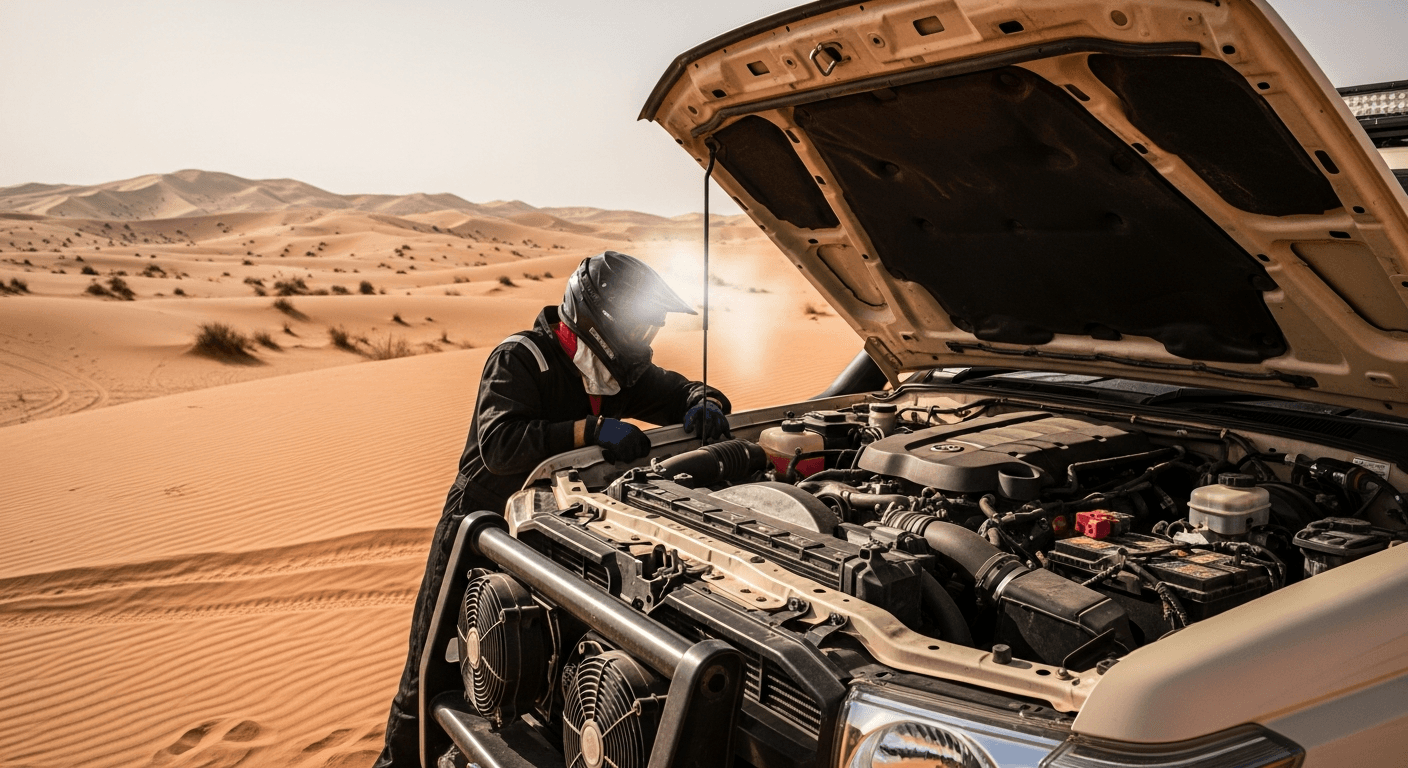
The first thing summer punishes is your cooling system. Long, slow grinding through soft sand with the air-con running is about the hardest work an engine does, and it's doing it when the ambient air is already 45°C-plus. Anything marginal — a tired radiator, a slipping fan belt, low or old coolant — will pick the worst possible moment to let go.
So before the season, do the boring stuff. Get the cooling system checked and the coolant flushed if it's due. Clear any sand and bugs packed into the radiator fins. Make sure the air-con is actually cold, because you'll be leaning on it. If you run an automatic, an auxiliary transmission cooler is a genuinely worthwhile addition for desert use — autos make a lot of heat in sand, and keeping that fluid cooler buys you reliability. Just have it fitted by someone who knows the vehicle rather than treating it as a magic fix.
The other quiet killer is the battery. Heat is far harder on batteries than cold is, and a lot of summer no-starts are just a battery that was already on its way out. If yours is a few years old, get it load-tested before you head out, and carry a jump pack regardless.
The driving gets gentler, not more aggressive
People assume hot sand means you need to attack it harder. It's the opposite. The thing that ends summer trips early is a car that's overheated, and you overheat a car by sitting in deep sand at high revs trying to power through.
Drive smoother. Read the line ahead so you're not constantly stopping and restarting, because every dig-out from a standstill in soft sand is heat and strain you didn't need. Keep momentum steady rather than stabbing the throttle. If the temp gauge starts creeping, stop on a firm crest where you can roll away again, point the nose into any breeze, pop the bonnet and let it breathe for a few minutes. That's not weakness, that's how you finish the day with a working car.
Tyre pressures matter as much as ever — drop them right down for the sand and air back up before the road. There's no special summer number; you read the sand and the car like always. If you want the full rundown on getting pressures right, our tyre pressure guide covers it properly.
A word on recovery gear in the heat: if you do get stuck and need a winch, don't run it flat out continuously. Short pulls with pauses let the motor cool. And everything metal — shackles, recovery points, even the bonnet catch — gets hot enough to burn you after sitting in the sun. Keep a pair of work gloves in reach.
Water, shade and knowing the symptoms
This is the part that actually keeps you alive, and it's the part newcomers underestimate. Carry far more water than you think you need — several litres per person for a short morning, more if you're staying out — and keep it in the cooler so it's not undrinkable warm when you need it. Throw in some electrolyte sachets too; plain water alone when you're sweating hard isn't enough.
Have shade you can deploy that isn't the car. If you break down, the inside of a stopped car in summer becomes an oven within minutes, so an awning, a tarp, anything that gets you out of direct sun matters. Learn what heat exhaustion looks like — headache, nausea, stopping sweating, confusion — because in a group it's usually someone else who notices before you'll admit it about yourself. The move is always the same: get them cool and hydrated immediately, before worrying about the car.
Go early, go close, go with people
The timing rule is simple: drive in the cool early hours and be heading home before the heat peaks. A dawn start gives you a few good hours; by late morning you want to be done. Trying to push on through the middle of the day is where summer trips go wrong.
Stay close to civilisation and pick areas with phone coverage and obvious exit points. Summer is not the time for remote, committing runs deep into Liwa or anywhere a recovery would take hours. Keep your loops short and your exits known. And don't go alone — a second vehicle isn't a luxury in summer, it's the thing that turns an emergency into an inconvenience. If you don't have a regular group, a club is the easiest way to find people who run sensible summer trips.
If you're still building the basics, honestly, wait for the cooler months and learn then. There's no shame in treating June through September as the off-season. The dunes will still be there in October.
Reviewed by experienced desert drivers. Our team personally visits operators and tests courses across the UAE.
Explore the Directory
Find off-road clubs, courses, garages and events across Dubai & UAE.
View Directory →